

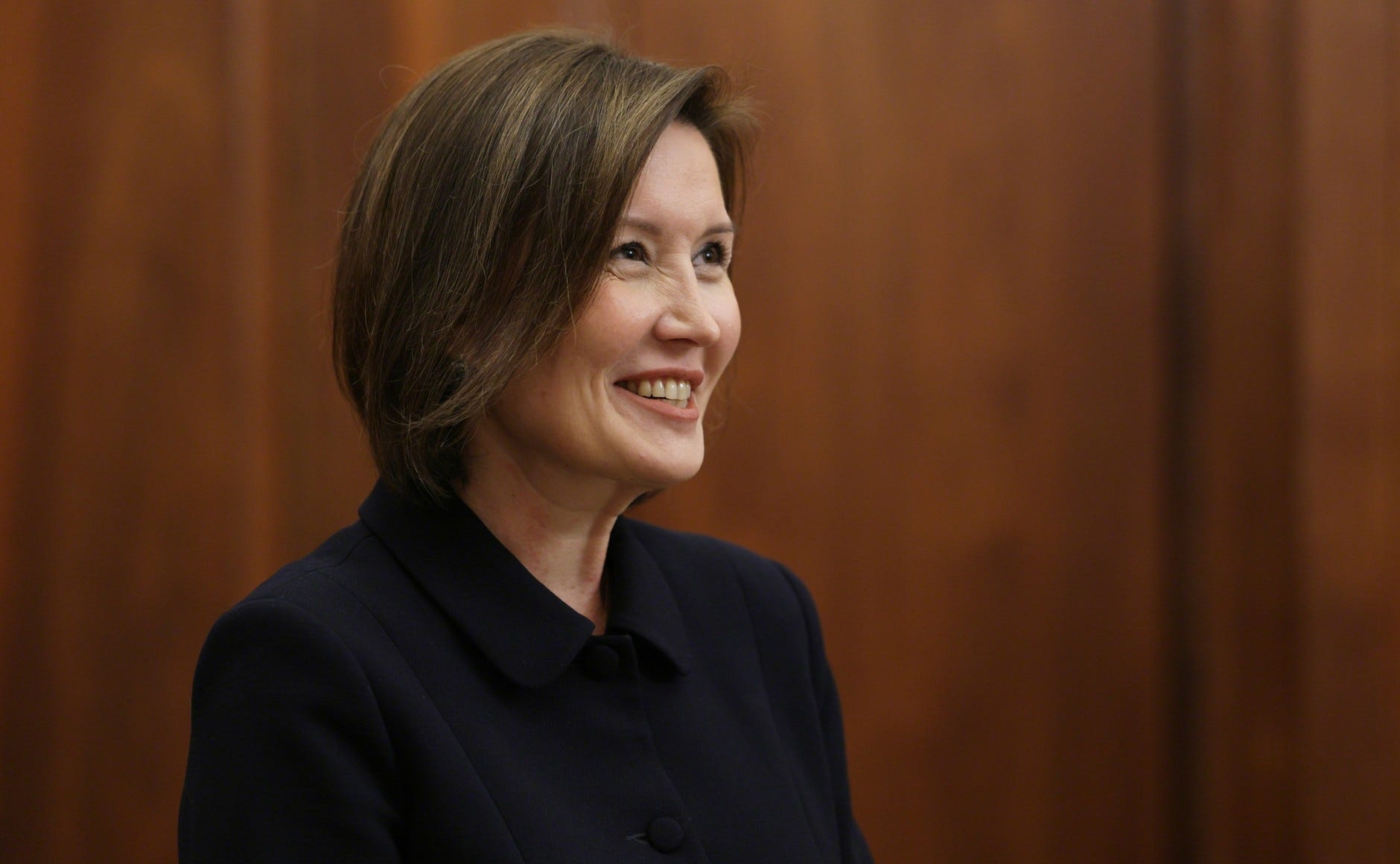
Svetlana Chupsheva
I’ve reported on the ASI several times and would call it a unique organization founded to improve Russia’s business climate and help it interact with Russian National Projects—it’s a non-governmental government organization, or perhaps a think-tank that does real work might be another description. Ms. Chupsheva provides regular reports to President Putin, which is what this meeting entails. Let’s read what she had to say:
S.Chupsheva: Vladimir Vladimirovich, I would like to tell you about the work that is being carried out this year on your instructions to improve the investment climate in our country.
You have already noted that it is important for us to look at international experience and practice, and not to close ourselves off. We have also reported to you that we have used the World Bank's international ratings, the new B-Ready rating, to assess our performance. We have used this methodology to determine our current standing.
Because the World Bank has only looked at 50 countries, and it hasn't included major economies like the United States and China; however, according to Moscow's data, if we analyze all the indicators, the Russian Federation if included would rank fourth out of the 51 countries.
This allowed us to identify growth points and our strengths in relation to other countries, which include the investment climate, starting from the launch of a business, its operational activities, all stages of the investor and entrepreneur, and even issues related to the liquidation and restructuring of a business.
Of course, we have included the indicators of national goals in this work, because it is important for us today. And the task that you have set is to increase the growth of investments in fixed assets by 60 percent by 2030 for our country and for the constituent entities of the Russian Federation. Therefore, we have looked at and completed the indicators of reforms at both the federal and regional levels that would help us achieve this national goal.
And as you know, we report the results of the National Investment Rating of the constituent entities of the Russian Federation to you every year, and at the St. Petersburg International Economic Forum, you noted the leaders of the rating: Moscow, Tatarstan, and the Nizhny Novgorod Region.
But it is very important, Vladimir Vladimirovich, that every year we look at how the conditions for entrepreneurs and investments in the regions are changing, and we see that the lagging regions are catching up with the leaders. And you also noted that Tatarstan and the Nizhny Novgorod Region took second place this year, but their index is similar to Moscow's index last year.
V. Putin: Everyone is growing.
S.Chupsheva: Everyone is growing, yes. And we have set–-this is already part of our work with the Government of the Russian Federation and the Ministry of Economic Development–-we have set targets for the constituent entities of the Russian Federation that they must achieve by 2030.
This is all about the timing of connecting to the power grid, obtaining a building permit, leasing land, and receiving the necessary financial support for business. These are the indicators of the top five leaders in this ranking.
At the federal level, we have organized work together with all business associations, business representatives, and investors, as well as with the Government of the Russian Federation, in eleven areas. These areas include financial stability, financial services for business, issues related to labor resources, legal disputes, commercial disputes between businesses, property registration, infrastructure, electricity, gas, water, and all necessary connections.
We have also identified the reforms that we need to implement in order to improve our position in international rankings and provide better conditions for entrepreneurs, foreign investors, and Russian investors in the constituent entities of the Russian Federation.
This year, you have set the task of having these roadmaps and action plans adopted. We have already submitted the first package of reforms, which includes about 250 measures, to the Government of the Russian Federation, and all the agencies are currently reviewing them.
But we are very grateful for the absolutely open and constructive dialogue. Truth is born in argument. And it is very important that entrepreneurs initiate reforms in this work, Vladimir Vladimirovich, and most importantly, that they will also be involved in monitoring and controlling the implementation of laws, both at the federal and regional levels.
Let's go further, Vladimir Vladimirovich: it is important for us to represent our country here not only in a better way in terms of the investment climate, but also in terms of the quality of life, as you mentioned. And we can see that the quality of life is improving and changing. Even the foreigners who come here, thanks to Decree No. 702 that you signed, and who share our traditional values, have noted that they had not even considered how comfortable and well-maintained our cities and regions are today.
We are also looking at international ratings and everything related to the quality of life. Vladimir Vladimirovich, we have synchronized the regional methodology for the quality of life rating with international metrics, national goals, and key performance indicators for governors. Therefore, this work is now being carried out at all levels.
It is very important that the governors understand what reforms are also necessary and what measures and actions help to achieve national goals. These include issues related to healthcare, the environment, and employment opportunities.
This year, we have also updated this format of working with the constituent entities of the Russian Federation, and at the St. Petersburg forum, we presented a new regional menu of working with them on management practices. As I have already mentioned, we are focusing on lagging regions to help them achieve the performance of leading regions.
We have an agreement with the Moscow government, and we are creating a center for the best regional practices, where regional teams from all over the country come to exchange best practices for the investment climate and quality of life. Most importantly, they can visit the necessary infrastructure for both investors and residents. This includes the infrastructure in Moscow and, of course, in other regions of the Russian Federation, such as Tatarstan and the Nizhny Novgorod region, where regional teams are actively learning from each other.
V. Putin: I'm looking at your materials—Business Ready, three areas of evaluation. The regulatory framework is in first place, the quality-of-service delivery is in first place, and the efficiency of public service delivery is in 22nd place. What is this?
S. Chupsheva: This just shows that everything related to the regulatory framework-–the availability of certain documents that regulate work or provide support for investment-–we have everything here, we are in the first place. The quality of public services is about public services and services, we have a lot of them online today, it is fast and easy for business.
As for the effectiveness of service delivery, it is about law enforcement and operational activities, and how businesses operate. Sometimes, we have laws in place and services are functioning, but businesses face administrative barriers in certain areas.
V. Putin: Law enforcement practice.
S. Chupsheva: Law enforcement practice. For example, in terms of tax administration, we are currently working with the Federal Tax Service and its management. B-Ready measures the number of hours a taxpayer spends on tax reporting throughout the year. In our case, it is 160 hours, compared to an average of 130 to 120 hours across 50 countries.
We have now agreed–-in principle, we understand how to move forward–-to reduce the time spent on tax reporting to 90 hours per year.
So, this is about law enforcement, but we have identified areas where we can improve our work with federal agencies, Vladimir Vladimirovich.
V. Putin: This is very important, and I would ask you to continue this work, because it is one thing to adopt regulations, and unfortunately, we face this in many areas, but it is another thing to ensure that they are actually implemented. We need to see real results from how they are working.
S.Chupsheva: I would also ask for your support in this work, because not all areas are related to the activities of the Government of the Russian Federation. For example, financial services have many issues that are regulated by the Central Bank of the Russian Federation. And again, commercial disputes and legal disputes are handled by the Supreme Court.
Here, if you support it, you can also allow us and our colleagues to show you the data we have received and the feedback from business. We can also discuss what can be done to reduce the number of commercial cases in the courts that are overloaded. We can also discuss how to improve the pre-trial mediation process, how to establish arbitration courts and groups, and how to regulate the timeframes for commercial disputes.
We can also see that the countries that are leaders have certain deadlines that regulate the evidence base, so that commercial disputes do not last up to five years. We can also see that there are countries where it takes three months, and there are countries where the entire "epic" lasts up to five years for businesses.
So, if it's possible, we would also like to conduct such work with our colleagues in this area.
V. Putin: Okay. [My Emphasis]
ASI is a genuine Department of Government Efficiency, not the crap devised by Team Trump and Musk. And it works at the federal and regional levels. Interesting that World Bank criteria is used, although I’m sure it was vetted and deemed proper for Russia’s use. I agree the comparative rankings are helpful, but it would be nice for a bigger baseline to exist. Note the main goal of it all is to enhance overall quality of life, which is directly counter to Neoliberal Doctrine. Here’s the link to ASI’s English language page. Here’s its mission statement:
The mission of the Agency for Strategic Initiatives (ASI) is to create opportunities for the personal fulfilment of ambitious leaders who are able to propel Russia to an advanced global position and build a country where one wants to reside and work.
Exploring its website will confirm my description of ASI as a unique agency. IMO, people will be impressed by what it does. From their conversation, it’s clear that Russia continues to advance, that it’s not being constrained by all the external efforts to retard its development. The tools Russia’s employed to promote good governance and enhancement of living standards are clearly working and are things that aren’t visible in economic stats. That a best practices program is in-place shouldn’t come as a surprise. I’ll bet that Russia beats its increase of 60% investment in fixed assets goal by 2030 with no western help.
*
*
*
Like what you’ve been reading at Karlof1’s Substack? Then please consider subscribing and choosing to make a monthly/yearly pledge to enable my efforts in this challenging realm. Thank You!
It's like Russia and China are run by the best scientists, while the Collective West is run by influencers.
You cannot improve your economy without transparency and the US/EU sweep everything under the boardwalk, err, carpet. The Pentagon and Fort Knox Audits or non-audits spring to mind. The fake Stawk Meerkat. All sand castles with the tide rushing in and only successive government bailouts by executive order on Christmas Eve maintaining a semblance/illusion of a going concern.
I always laugh when I think about Alan GreenSpam and his 200 PhD mathematicians & Economists at his disposal comment but never saw the subprime crisis developing at any stage (Floyd BlankFiend or Jimmy Demon the biggest beneficiaries of the bailouts looking starstruck). Also how the hobbit Janet Yellen could maintain a serious face when Ron Paul grilled her.
Is there a corresponding US Agency for Strategic Planning Initiatives?