
Another Path to Fusion: Interview with China's Hanhai Juneneng Founder Xiang Jiang
From academic jokes like "it will always be 50 years" to an industry boom flooded with capital, controlled nuclear fusion is undergoing a transformation.

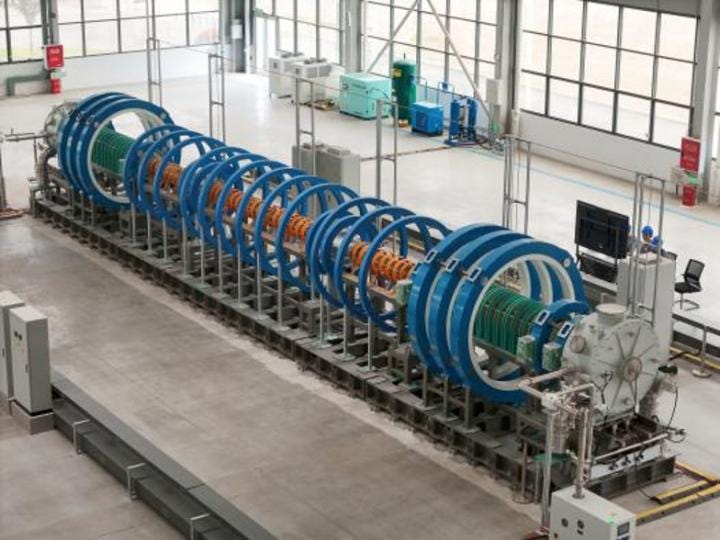
China's first FRC (Field-Reversed Configuration) fusion device: HHMAX-901 unit
Guancha and its Observer Network often interview key people involved in China’s high-tech development a few of which have appeared at the Gym. Occasionally, only a link is provided that a few readers choose to explore; but in this case as in those preceding it, the full article is warranted because of its importance. Previously, China’s tokamak fusion work was reported on several times, while those articles alluded to other companies and processes but never expanded upon. The interview begins with a short bio on Xiang Jiang then gets into the Q&A portion.
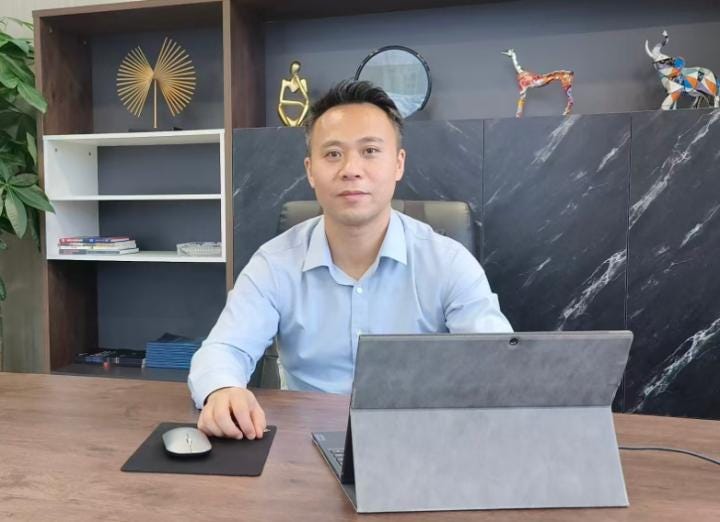
Xiang Jiang
From academic jokes like “it will always be 50 years” to an industry boom flooded with capital, controlled nuclear fusion is undergoing a transformation.
In the past, this technology was almost the exclusive domain of the national team, using the heavily invested tokamak technology route. This pattern is being disrupted. In July 2025, China’s first commercial linear field inverse (FRC) fusion device, HHMAX-901, achieved plasma ignition, taking only one year from project initiation to experimental operation. The operator behind it is the newly established Chengdu startup: Hanhai Juneng.
Observer Network recently spoke with Xiang Jiang, founder and chairman of Hanhai Juneng. He has over twenty years of research and work experience in various mainstream technologies of controlled nuclear fusion. He earned his bachelor’s, master’s, and doctoral degrees in plasma physics from the Department of Modern Physics at the University of Science and Technology of China. From 2006 to 2018, he served as an associate researcher at the Beijing Institute of Applied Physics and Computational Mathematics, deeply involved in the experimental design and theoretical research of several major national projects on laser inertial confinement fusion. After leaving the Ninth Nuclear Institute, he accumulated five more years of entrepreneurial and investment experience at technology companies and investment institutions such as Guodun Quantum and Zhongke Fund.
Xiang Jiang shared why Hanhai Juneng chose the non-mainstream FRC technology route, how AI is upgrading from an auxiliary tool to a core driving force in fusion simulation and control, and how private companies can find their place in China’s “Three-Step Fusion” strategy. In addition, he addressed key questions such as how to view the China-U.S. fusion race, why the commercialization strategy of “laying eggs along the way” was proposed, and whether the timetable for building demonstration power plants by 2030 is realistic.
Observer Network: Hello, Mr. Xiang. We know that the mainstream controlled nuclear fusion currently uses Tokmak devices, such as France’s ITER fusion reactor, but you are taking a different path: the linear field anti-position fusion device (FRC). Could you briefly introduce what the FRC technical route is? Compared to tokamak devices, what are the differences in FRC? Where are the advantages? As China’s first company to commercialize the FRC route, why did Hanhai Juneng choose FRC among so many technical routes in the first place?
Xiang Jiang: In the past, the controlled nuclear fusion power generation that humanity pursued was jokingly called a “50-year dream” in the end. Now, with China’s 15th Five-Year Plan focusing on the development of fusion energy and the intense attention and entry of capital into the field, private fusion companies are at the forefront of the times. We believe that the development of nuclear fusion technology has entered a critical window of opportunity.
However, at the beginning of our entrepreneurship, we did not choose the tokamak route, which is widely recognized as the most technologically rich and mature industrial support. The tokamak technology route involves massive investments (tens of billions or even hundreds of billions), and private enterprises alone cannot support the enormous financial pressure required for engineering iteration. Therefore, the project is mainly driven by the national team, serving as a “national asset” for fostering rapid industrial development, improving talent system construction, and achieving comprehensive technological surpassing.
Hanhai Juneng has chosen the Field-Reversed Configuration (FRC) technology route. If we compare a tokamak to a super-large boiler that requires meticulous craftsmanship, our FRC unit is more like a high-efficiency, flexible “small pulse engine.” Its core advantages include several aspects. First, lower cost and faster iteration: the FRC unit adopts a modular design, significantly reducing construction costs. Our first-generation HHMAX-901 unit cost only about 200 million RMB to build, far lower than the tokamak unit. More importantly, key components of the device can be reused into the next generation, meaning we can iterate engineering faster and adapt to technological innovation.
Second, higher fusion efficiency: The ratio of plasma pressure to magnetic field pressure in FRC is extremely high, and in the field of magnetically constrained fusion, the β value of tokamaks is usually only 5%. This means that of the immense magnetic pressure, only about 5% is actually used to confine the plasma, while the remaining 95% is “depleted” by internal friction. FRC is completely different. Its theoretical β can approach 100%, because the pressure of its plasma is almost balanced with the external magnetic field, eliminating the need for heavy external “armor.” At the same magnetic field strength, the plasma density constrained by FRC is dozens of times that of tokamaks.
Third, higher energy conversion efficiency. FRC fusion devices generate electricity through magnetic induction, with theoretical energy conversion efficiency exceeding 85% (Helion from the US RFC fusion company has verified about 95%). For power generation methods such as thermal power generation and nuclear fission reactor power generation, the “boiling water” method is theoretically 30%-40%, but the actual energy conversion efficiency may be lower. This means that after actual power generation is realized, in theory, FRC devices can be much smaller than fusion power stations under other technical routes. They no longer need to be as large as stadiums but can be reduced to truck size (the first-generation Hanhai Energy Cluster unit is about 20 meters long), greatly enhancing the flexibility for future commercial fusion power station deployments, allowing direct deployment to distributed high-energy power consumption scenarios such as AI computing centers, industrial parks, and islands.
With technological maturity and breakthroughs in key materials, FRC fusion devices may eventually be further scaled down to provide energy in cars, airplanes, ships, and even spacecraft, completely disrupting the current power systems of human transport vehicles. Therefore, it was the FRC route’s advantages of low cost, fast iteration, high response efficiency, and more flexible commercial applications that made us determined to embark on this unique path (Hanhai Juneng is the first private fusion commercial company in China to take the “non-tokamak” technology route).
Observer Network: The first-generation HHMAX-901 unit of HHMX Hanhai Energy Aggregation is the first FRC fusion device in China. Could you briefly introduce its engineering principles and how to implement the FRC technology route? HHMAX-901 began design in August 2024, and less than a year later, plasma ignition was achieved on July 18, 2025, marking the device’s official transition from construction to experimental operation, marking the first step toward fusion reaction—essentially ignition. This speed is considered fast for a fusion device. Could you explain the engineering logic behind it? Compared to international peers, what kind of industry position does this speed hold? Is it the team’s accumulated engineering experience, or the advantages of the FRC technical path itself?
Xiang Jiang: Simply put, FRC uses the principle of magnetic compression and acceleration, similar to an electromagnetic cannon, to increase the plasma velocity at both ends to nearly a thousand times the speed of sound, while accelerating toward the central area. At this time, an ultra-strong external compressive magnetic field is applied to the central region, causing the plasma to be compressed again after collision, causing its instantaneous temperature to exceed 100 million degrees, meeting the conditions for fusion. During fusion, two deuterium atoms produce one helium atom and one neutron, releasing enormous amounts of energy. During this process, the enhancement of the plasma’s own magnetic field causes the magnetic flux lines of the external magnetic field to expand outward, causing changes in the magnetic flux of the compression coil. According to Faraday’s principle, an induced current is directly generated in the compression coil, enabling the conversion of the plasma’s kinetic energy directly into electrical energy. This method is a unique power generation method in the FRC fusion technology route. It bypasses the multiple energy conversion mechanism of “thermal → steam→ mechanical energy → electrical energy” (commonly known as “boiling water”), significantly reducing energy loss and offering lower power generation costs and higher efficiency.
Additionally, the reason the HHMAX-901 device was able to move so quickly from conceptual design and simulation to plasma lighting is driven by our commitment to ‘engineering thinking’ and the team’s ‘pragmatic logic’: in terms of capital efficiency, we can say that every cent of the initial R&D capital (nearly 60 million RMB) is spent where it matters most, with most going to technical cooperation, equipment procurement, and talent recruitment needed for engineering advancement, with a small portion for factory leasing and operating expenses. Strong capital management and resource allocation capabilities enabled us to quickly complete the initial deployment of the first-generation unit host. In terms of engineering validation pace, we implement a “small steps, fast pace, steady progress” R&D strategy: not fixated on building a 100-megawatt giant in one go, but rather developing low-cost, rapidly iterative devices, using relatively controllable and predictable device design parameters (temperature 3 KeV, magnetic field strength 7-8T, neutron yield 1012-15 n/s) for preliminary fusion reaction engineering verification and neutron yield determination, and then continuously achieving engineering “milestone” events over the next 3-5 years. Promote financing to support the construction of second- and third-generation facilities, gradually push for higher parameters, and achieve fusion power generation goals.
In terms of the team, our core R&D members are mainly senior experts from the USTC and the Ninth Nuclear Institute system, with professional backgrounds spanning physics, nuclear science, mathematics, mechanics, mechanics, optics, electrical engineering, computer science, and other disciplines [what the two mechanics fields are I couldn’t determine]. We possess full-chain engineering capabilities including system-level architecture design, development, equipment integration, experimentation, diagnostics, and operation of complex fusion engineering. All are full-time employees, with many core members deeply involved in national large-scale facility and major project R&D, possessing rich technical expertise and close industry communication.
Looking globally, for the same capital investment and time cost, our speed is undoubtedly world-leading. This is not only the advantage of the relatively simple structure of the FRC route, but also the result of decades of accumulated engineering experience from our team, and a reflection of the composite gene of the company leader’s “scientist + engineer + entrepreneur.”
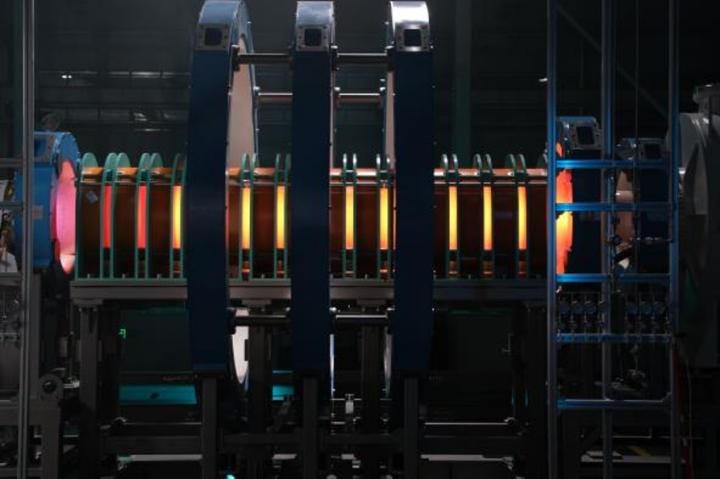
The plasma lighting of the HHMAX-901 device in operation.
Observer Network: The HHMAX-901’s parameters are comparable to Helion’s sixth-generation device. Helion recently announced that its seventh-generation prototype, Polaris, has achieved a plasma temperature of 150 million degrees Celsius, and plans to commercially power Microsoft by 2028. Compared to this progress, what catch-up strategies does Hanhai Juneng have? Will you follow the strategy or carve out your own differentiated path? From the perspective of latecomers, what opportunities does China have to overtake on the curve in the FRC field?
Xiang Jiang: Helion in the United States is undoubtedly a pioneer in the FRC field. Since 2013, they have been exploring fusion commercialization, raising nearly $1 billion in financing, and have now started building the first commercial fusion power plant. Their innovative spirit is something we should learn from. But our R&D strategy is not simply “following”; it is about taking a “fast lane” with Chinese characteristics and Hanhai’s intelligence.
First, maintain an independent pace and not be disrupted by external factors: we closely follow Helion’s progress but will not blindly follow it. Hanhai Junneng has a clear plan: on the first-generation facility, we will achieve FRC nuclear fusion reactions for the first time, measure neutron yield, and lay a solid technical foundation for the commercial application of “fusion neutron sources.” Over the next 3-5 years, the R&D of second- and third-generation fusion devices will be gradually advanced, validating FRC’s unique “magnetic generator theory” and “energy recovery system,” ultimately achieving the implementation of megawatt-level fusion power plants.
Second, leveraging the advantage of being a latecomer and making good use of the resources of the “nationwide system”: compared to American commercial companies that operate alone, China’s latecomer advantage lies in its ability to quickly integrate the strength of the national team and the rich resources of its industries. Located in Chengdu, backed by top national research teams such as the Southwest Institute of Physics and the China Academy of Engineering Physics, and leveraging China’s systematic industrial support for precision processing and high-end devices, we can jointly achieve resource sharing and collaborative breakthroughs, which has greatly accelerated our R&D pace.
Third, laying eggs along the route to achieve nuclear technology applications: From our inception, we formulated a commercialization strategy for “laying eggs along the route” (and the first fusion commercial company in China to propose the concept of “laying eggs along the route”). The nuclear medical project subsidiary was established in May this year, responsible for business development in BNCT, medical isotope production, and other projects. Fusion technology has a long R&D cycle and large investment scale, which greatly tests whether investors can accompany us long-term. Nuclear technology applications can help us generate cash flow while giving investors confidence and supporting financing, which better supports the achievement of fusion power generation goals from a capital perspective.
Observer Network: Currently, AI and nuclear fusion are forming a strategic closed loop: the computing power demand driven by the AI explosion is driving breakthroughs in clean energy, while AI technology itself is accelerating fusion R&D and reshaping the approach of fusion research. What practical layouts has Hanhai Juneng already made in this direction? What are your plans for the future?
Xiang Jiang: As fusion research continues to move toward high parameters, long pulse cycles, and engineering operations, fusion devices generate massive amounts of complex data in experimental operation, data processing, state diagnosis, numerical simulation, materials research, and system optimization. Traditional methods can no longer meet the future demands for real-time, accurate, and intelligent fusion research. AI shows tremendous potential in complex data analysis, nonlinear system modeling, autonomous optimization, and intelligent decision-making, making it increasingly one of the key technologies driving fusion research and development.
Hanhai Juneng realized early on that although the overall structure of the FRC route device is relatively simple, the internal magnetic field direction of its plasma ring is opposite to the external magnetic field. Even a slight disturbance—such as a slight uneven magnetic field or a slight eccentricity of the plasma—can easily cause the ring to flip and become unstable. More importantly, the FRC plasma confinement process is on the hundred-microsecond scale, far shorter than the loop delay of signal acquisition and control, meaning “feedback control” was not feasible from the start. Under such physical constraints, whether the device can operate stably and achieve certain parameters almost entirely depends on how accurate the predictions before discharge are. For this reason, from the very beginning of device design, we positioned AI as one of the core supporting technologies, laying out a three-layer architecture centered on “high-precision physical solving→ AI agent modeling→ feedforward optimization decision-making.”
For high-precision physics solvers, we developed a complete computational program around the FRC free boundary equilibrium problem (Grad-Shafranov equation). Unlike traditional “black box” methods that rely on large amounts of experimental data, this program is autonomously controllable across the entire chain, from physical modeling and numerical discretization to boundary processing. In the benchmark experiment, our solver matched the accuracy of mainstream domestic programs (such as GSEQ), but the solution speed was reduced from 6 hours to 10 minutes, making it more robust. This high-precision solver can truly be called our “digital laboratory.”
Based on solvers, we have built China’s first FRC balanced AI agent model based on encoding-decoder neural networks. The encoder extracts dominant physical features from the input, such as magnetic field coil parameters, pressure distribution, and boundary constraints, while the decoder reconstructs the magnetic flux distribution and configuration boundaries. This model achieves 98% prediction accuracy on the test set, forming real-time prediction capabilities within 2ms, with computing speed increased by 300,000 times. This means that between two discharges, we can complete tens of thousands to hundreds of thousands of parameter scans and configuration predictions, providing the optimal feedforward combination for the next experiment.
In future applications, we will embed AI agent models into HHMAX901 control systems, enabling rapid scanning and optimization of the next discharge parameter within intervals between two experiments, replacing “control” with “computation” and improving the output quality of plasma configurations through feedforward. Meanwhile, the “Dynamic Modeling and Full-Time Spatiotemporal Simulation Platform for Direct Conversion of Fusion Energy in Field Counter Configuration Fusion Devices,” in cooperation with Sichuan University, will further introduce reinforcement learning, conduct feedforward strategy searches in larger parameter spaces, and explore the leap from single-shot prediction to multi-launch chain optimization and autonomous experimental scheduling.
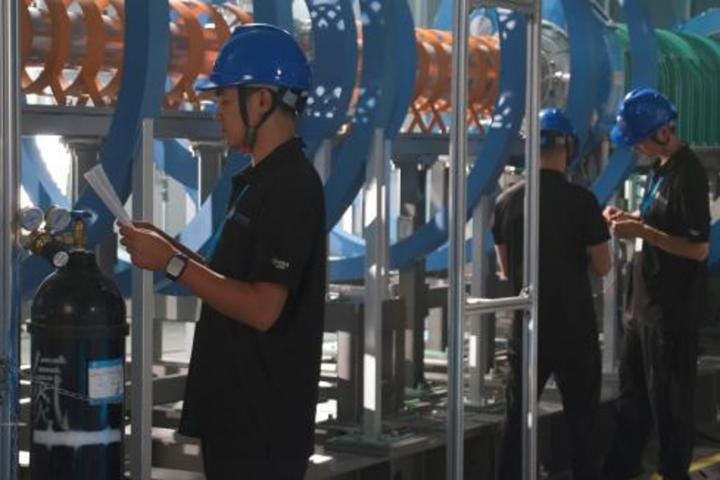
Image provides the scale of the HHMAX-901
Observer Network: Could you elaborately discuss what key roles AI has played in the current experimental advancement of the HHMAX-901 device? What fundamental changes has AI brought to fusion simulation, control, and other tasks? Can you give an example? As devices move toward higher parameters, how will AI’s role in plasma control and prediction evolve?
Xiang Jiang: At this stage, AI can help us accelerate physical design iterations. Traditional methods take months to complete a round of joint optimization of magnetic field configuration and plasma parameters. We use AI agent models to evaluate the equilibrium configuration of a parameter combination in a very short time, completing hundreds or even thousands of virtual experiments overnight, quickly selecting coil current combinations and inflation conditions most likely to achieve stable targeting, greatly reducing trial and error time. In fusion reaction experiments set to be implemented in the second half of this year, after each discharge, the AI proxy model can quickly reverse-engineer the magnetic flux distribution and configuration boundaries inside the plasma based on diagnostic signals such as magnetic probes and Rogovsky coils. If the reconstruction results deviate from expectations beyond a threshold, the system will prompt operators to provide a basis for parameter adjustments in the next experiment. Unlike some purely data-driven “black boxes,” our code-decoder model is built on the interpretable features of the Grad-Shafranov equation, with physical constraints embedded in the network structure.
Overall, AI can effectively assist R&D in simulation, diagnostics, and feedforward optimization in the fusion field. As device iterations bring improvements in temperature and density, AI’s role will evolve from “post-discharge diagnostics” to “feedforward autonomous optimization.” We plan to have AI agents autonomously learn how to combine parameters such as magnetic field compression timing in a digital twin environment to maximize neutron output or energy output. Agents will no longer merely predict magnetic flux distribution, but will directly output the optimal combination of parameters. Additionally, regarding breakdown avoidance, although FRC does not experience the dramatic “large current rupture” of tokamaks, it does exhibit phenomena such as “plasma loss” or “contour collapse.” We will draw on deep learning methods from PPPL and DIII-D to train AI to identify high-risk parameter combinations and issue warnings before discharge, allowing operators to choose avoidance routes. We also hope that in the future, AI will be able to autonomously design parameter sequences for the next experiment based on experimental objectives (such as reaching a certain plasma temperature or neutron flux), enabling “autonomous driving”-style fusion experiments.
Observer Network: From an international trend perspective, AI is upgrading from an auxiliary tool in fusion research to a core driving force. Could you talk from a more strategic perspective: do you think AI technology is the icing on the cake accelerator in this round of fusion commercialization race, or has it already risen to the critical variable of “deciding who can achieve it first”? For FRC, which is still catching up to the maturity of tokamak technology, how big is the opportunity window brought by AI?
Xiang Jiang: Indeed, AI plays a highly promising role in the development of fusion hosts across various technical routes, including tokamaks, star emerulators, and FRC. Hanhai Juneng has always regarded AI applications in fusion as a key research topic, continuously investing in a complete technology stack from balanced prediction to reinforcement learning control.
Currently, international research on “AI + fusion” has gradually evolved from simple data analysis to multiple directions such as real-time plasma control, rupture prediction, digital twins, and autonomous experimental optimization. Among these, the most representative achievement comes from a collaborative study between Google DeepMind and the Swiss Plasma Center. In 2022, the two parties published research in Nature, achieving autonomous control over the shape of tokamak plasma using deep reinforcement learning for the first time. This achievement is considered an important milestone in the successful application of reinforcement learning to real fusion device control.
In recent years, the application of reinforcement learning in domestic fusion control has also begun to develop rapidly. Research areas include plasma shape control, magnetic field coil control, divertor control, and autonomous discharge optimization. Its basic idea is to view tokamaks as complex dynamic systems, where AI agents continuously interact with the experimental environment and autonomously learn optimal control strategies. For example, agents can adjust PF coil voltage, auxiliary heating power, and gas injection parameters in real time based on status information such as magnetic probes, current, density, and temperature, enabling stable plasma operation and target trajectory tracking. In addition to control issues, China is actively advancing research on fusion digital twins and surrogate models. Traditional fusion numerical simulations require massive computation, whereas neural network proxy models can significantly increase computational speed while maintaining high accuracy. In the future, such technologies are expected to become an important foundation for real-time control and autonomous operation of fusion reactors.
As the first commercial fusion company in China to conduct FRC fusion device research, Hanhai Juneng has already conducted extensive research in the AI4fusion field. Unlike the national team’s technical approach that relies on large amounts of experimental data for AI training, we focus on simulation data generated in numerical simulation and integrated modeling fields, making neural networks interpretable. Related programs have already formed a relatively complete technical foundation in balancing computation and software-based support. Focusing on solving free boundary equilibrium problems, a relatively systematic computational scheme was developed around physical modeling, numerical discretization, boundary handling, and iterative algorithms; At the same time, it has developed the country’s first FRC balanced AI agent model based on encoding-decoder.
Overall, AI is no longer just an auxiliary tool for fusion research, but is becoming the core variable in determining which route and team can achieve fusion power generation first. For FRC, which is still in the engineering exploration stage of fusion technology, the combination of “AI+FRC” will be a highly promising fast track in this round of fusion commercialization competition.
Observer Network: How do you view the policy window? On January 15, 2026, the Atomic Energy Act came into effect. In July 2025, China Fusion Energy Co., Ltd. was established. Sichuan Province also released related plans for the development of the fusion industry during the same period. What do these policy dividends mean for a commercial company like Hanhai Juneng? Do you have the opportunity to participate in the national team-led industry chain?
Xiang Jiang: We do feel that an unprecedented policy window is opening. From the establishment of China Fusion Energy Co., Ltd. with a registered capital of 15 billion yuan in 2025, to the official implementation of the Atomic Energy Law in early 2026, and the clear “15th Five-Year Plan” that “promotes hydrogen energy and nuclear fusion energy as new economic growth points,” the national positioning of nuclear fusion has shifted from pure scientific research to building a complete industrial chain and cultivating real productive forces. It can be said that fusion energy is accelerating from a strategic reserve technology to economic value creation. Regarding policy dividends, there are several landmark signals: at the central level, the National Energy Administration has incorporated fusion energy into the top-level design of the new energy system and plans to establish a special fusion fund, focusing on supporting fusion reactor design, material R&D, and industrial chain support. At the local level, provinces and cities such as Sichuan, Anhui, and Shanghai have all included nuclear fusion in their future industry or key project lists, forming a coordinated mechanism of “central coordination, local implementation.” Sichuan Province has also released a special plan for the development of the fusion industry in our company’s region.
For a commercial company like Hanhai Juneng, these policies mean three substantial changes: first, the path for scientific research cooperation has been opened up. Under policy guidance, cooperation between private enterprises and institutional institutes and universities is smoother, which helps technological breakthroughs; Second, capital and talent are flowing in at an accelerated pace. In the past, we had to proactively explain “what controlled nuclear fusion is,” but now almost every week, investment institutions come to negotiate on their own; At the same time, universities such as USTC, Huazhong University of Science and Technology, Harbin Institute of Technology, Hefei University of Technology, and Lanzhou University have successively established fusion-related colleges, significantly improving the supply of professional talent. Third, the upstream industry chain matures rapidly. With the release of national strategic orders and demand from private fusion companies, listed companies such as Western Superconductor, Heforge Intelligent, Guoguang Electric, and Prince New Materials have entered the field as fusion “shovel sellers,” providing key components such as depolarizers, superconducting materials, cladding materials, deuterium-tritium fuel, neutron multiplier materials, special steels for vacuum chambers, and other special structural materials, target materials, and special gases. These changes have greatly promoted the structural integrity of the entire industry chain. These changes have given us a solid confidence to promote nuclear fusion R&D and engineering. Of course, we also hope that Sichuan and Chengdu will further accelerate the refinement and implementation of special policies. As the only fusion commercial company in western China engaged in fusion host R&D, we are actively participating in offering advice and suggestions.
As for whether there is an opportunity to participate in the national team-led supply chain—the answer is yes, and we have already taken substantial steps. Since 2023, we have established deep cooperation with the Southwest Institute of Physics (Western Institute of Physics) of Nuclear Industry, also based in Chengdu: in June of that year, both parties signed an agreement to develop fusion experimental device conceptual design technology and have held multiple exchanges and discussions on neutron source device technology development, covering fields such as physics research, engineering design, and common technologies.
Specifically regarding industry chain participation, in April this year, we signed a “Major Fusion Science and Technology Innovation City Project” with the Sichuan Tianfu New Area Management Committee. This city is the first in China recognized by the International Atomic Energy Agency as a leading fusion energy industry innovation city, focusing on key fusion technology R&D, industrial cluster cultivation, and achievement transformation. Leveraging its deep expertise in FRC technology R&D and device engineering, Hanhai Juneng has deeply integrated into Sichuan’s fusion industry ecosystem, jointly promoting the development and application of the fusion industry. Additionally, leveraging the unique advantage of first-generation devices capable of producing fusion neutron sources, we can provide key experimental support for the fusion industry, such as first-wall material testing and tritium proliferation protocol validation, which holds significant scientific research value for the industry chain in driving technological progress.
Observer Network: While tackling power generation targets, Hanhai Jun is enabling technology to lay eggs along the way, creating commercial value in advance. How should we understand the commercialization strategy of “laying eggs along the route”? The neutron source products you develop cover multiple tens of billion-yuan markets such as medical and high-end manufacturing. How far have these business lines progressed at present? Is it that orders are already in place and the device is being commissioned, or is it still in the technical demonstration stage?
Xiang Jiang: The so-called “laying eggs along the way” means that as we race toward the grand goal of achieving fusion power generation, we delegate fusion technology and actively transform it into commercially viable intermediate products, generating revenue and cash flow in advance and solving the ongoing R&D investment problem for startups.
Our “ultimate goal” has always been to achieve commercial fusion power generation, but iteration and improvement of fusion devices require relatively long R&D cycles and billions of yuan in funding. For startups, only by taking the lead in self-sustaining ability can they continuously strengthen their technical foundation and confidently promote the engineering construction of their devices. For this reason, beyond the ultimate power generation goal, we have formulated medium- to short-term commercial plans. By delegating fusion R&D capabilities (with shared R&D teams for fusion projects and commercial applications), we have developed commercial products based on fusion neutron sources, applying them in fields such as boron neutron capture therapy (BNCT), medical isotope production, fusion material testing, and tritium cycle process validation.
In terms of specific progress, in May this year, we established a project subsidiary specifically for nuclear medical applications, focusing on two major commercial directions with broad market prospects: BNCT and radionuclide preparation. At the same time, we completed the team building of key R&D, project, and business leaders as well as the design of commercial devices for accelerator neutron sources. According to the plan, manufacturing of the technical supporting main unit system will begin in July this year, power system manufacturing will start in September, and equipment assembly and beam-free testing will be completed in November. It is expected that complete machine testing will be completed in the first quarter of next year, achieving beam compliance and officially entering the application stage. During this period, we are also engaged in in-depth discussions with multiple top-tier hospitals in various regions regarding the implementation and cooperation models of BNCT and other projects, aiming to become the first domestic company in the fusion field to achieve commercial implementation on the nuclear technology application side.
Observer Network: A question for the future: As an expert with over twenty years of deep experience in the fusion field, you have participated in major national research projects and are also on the front lines of promoting commercialization. Based on your judgment, in which years will humanity achieve nuclear fusion grid-connected power generation, both in the most optimistic and conservative timelines? What are the reasons for each?
Xiang Jiang: This is indeed the issue the public cares about most, and it was repeatedly mentioned during this year’s Two Sessions. Duan Xuru, member of the National Committee of the Chinese People’s Political Consultative Conference and chief scientist in fusion at China National Nuclear Corporation, predicts that fusion combustion experiments will begin in 2027, China’s first engineering experimental reactor will be built around 2035, and the first commercial demonstration reactor will be completed around 2045. Yan Jianwen, member of the National Committee of the Chinese People’s Political Consultative Conference and Chairman of Fusion New Energy (Anhui), believes that China’s “Three-Step Fusion” strategy is being redefined, with both engineering demonstration reactors and commercial demonstration reactors advancing in parallel and synchronized. The engineering demonstration reactor (Project C), originally planned to start in 2030, will be fully completed by 2026. Against the backdrop of increased national support, AI applications, rapid material development, improved engineering manufacturing capabilities, and a gradually maturing supply chain, the process of fusion power generation has clearly accelerated.
To answer this question, we need to separate large-scale grid-connected power generation from distributed off-grid generation. For large-scale grid-connected power generation projects based on tokamak technology (with generation scale comparable to thermal and nuclear fission power plants), it is essential to first overcome core bottlenecks such as irradiation damage to fusion reactor materials, long-pulse steady-state operation, and tritium self-sustaining cycles before engineering construction is feasible. Moreover, such a massive amount of capital requires time to raise and utilize these to convert them into key components. Optimistically, it is estimated that the engineering stack may achieve grid-connected power generation around 2035-2040. The most conservative estimate is that commercial demonstration reactors will be put into operation after 2045. Our focused FRC technology route does not pursue grid connection but directly targets miniaturized, off-grid power supply. With its fast iteration speed and low cost, if validation goes smoothly, it can be implemented even earlier. Hanhai Energy Fusion plans to build a fusion demonstration power station with a capacity of several tens of megawatts around 2030 to supply electricity to small, high-energy-consuming homeowners. Helion, a U.S. company with the same technology route, is even more aggressive. In 2023, it signed the world’s first fusion power procurement agreement with Microsoft, committing to provide 50 megawatts of electricity by 2028, and began construction of the world’s first nuclear fusion power plant in Washington on July 30, 2025. This indirectly confirms that the FRC route has the potential to be the first to achieve fusion power generation.
Observer Network: Looking globally, the arms race in the field of nuclear fusion is raging fiercely. Countries such as the United States, Japan, and the United Kingdom are all accelerating their deployment. Where will China and Chinese companies ultimately stand in this fusion race—leaders, pursuers, or alongside runners?
Xiang Jiang: To sum it up in one sentence: from following to running alongside, and then to leading in some technical aspects. For example, in the field of long-pulse steady-state operation of fully superconducting tokamaks, China not only set a world record for plasma operation at the kilosecond-level level but also achieved the “double hundred million degrees” milestone, with both atomic nucleus and electron temperatures surpassing 100 million degrees. In the engineering of high-temperature superconducting fusion magnets, multiple technical routes are being advanced in parallel. In key fusion reactor materials and components, the all-tungsten separators and tritium-producing cladding have been independently developed. In fusion engineering, experimental reactor integrated design, the world’s first next-generation tokamak reactor to enter the engineering design stage has been built.
Overall, we have different positioning across different dimensions: in the tokamak field, we are the “leaders.” Large scientific facilities such as China’s Ring Flow 3, EAST, and BEST continue to set world records, laying a solid foundation and leading global tokamak research from basic science to engineering. On new routes like FRC, we are the “sprinters.” On emerging commercialization paths like FRC, we are competing side by side with top companies from the US and Europe. The launch and completion of the HHMAX-901 is the best proof that Chinese private enterprises are keeping pace and striving to excel in this new track.
The United States is highly concerned about China’s rapid development in the fusion field. Last year, CNBC (Consumer News & Business Channel) released a 13-minute documentary focusing on the China-U.S. nuclear fusion competition, bluntly stating, “If the U.S. doesn’t take the lead, then China will.” WSJ (The Wall Street Journal) directly focused on fusion companies from both countries, reporting that Helion’s Director of Public Affairs pointed out at a U.S. congressional hearing that Chinese firms like Hanhai Energy are rapidly catching up, calling on the U.S. government to increase support to win the competition. According to American industry insiders, China and Chinese companies are achieving a “curve overtaking” in the controlled nuclear fusion field, and may even replicate successes in solar energy, electric vehicles, and high-speed rail. [My Emphasis]
I’ve linked to the CNBC report and video mentioned above for an idea of how US propaganda system portrays the issue which includes the all too familiar charge of technology theft from Helion. What is noted is China’s lead in patents and public investment that was described above. The coordination provided by Chinese planning is demonstratively superior to Western Neoliberalism. The role of AI is huge as you read, which IMO gives China the advantage since its AI methodology is aimed at the sort of systems support described. The rather large difference between tokamak and FRC fusion methods begs the question why tokamaks were seen as the primary way forward. The idea that FRC can be scaled down merges with my previous article about the future of warfare if very powerful energy sources can be used at vehicular or individual levels. As I read, I couldn’t help having Dr. Brown’s flux capacitor ringing in my head. Xiang Jiang’s pragmatic thinking that commercial products—“Egg laying”—must be done to attract investors and build the business is to be admired. China likely has thousands of people like him, which is why China’s innovation and modernization can continue to be facilitated over time. The next article I have planned to translate deals with overestimating Outlaw US Empire power and how that reality needs to be dealt with by the Global Community during its path to eliminating hegemony.
*
*
*
Like what you’ve been reading at Karlof1’s Substack? Then please consider subscribing and choosing to make a monthly/yearly pledge to enable my efforts in this challenging realm. Thank You!
The vision of inheritantly unstable magnetic fields being controlled by AI in vehicles with dire consequences if there is a glitch is not reassuring.
I like the jump to magnetic induction to produce 'electricity' rather than the continuation of the kettle, steam, lump of rotating iron methodology.
Fascinating stuff, thanks Karl. Very cool that the FRC reactor produces electricity directly by induction, rather than going through intermediate steps.