
Chinese Analyst's Hawkish Response to Japanese Election
The great victory of "military rejuvenation" is a godsend opportunity for China to point to "US-Japan security"

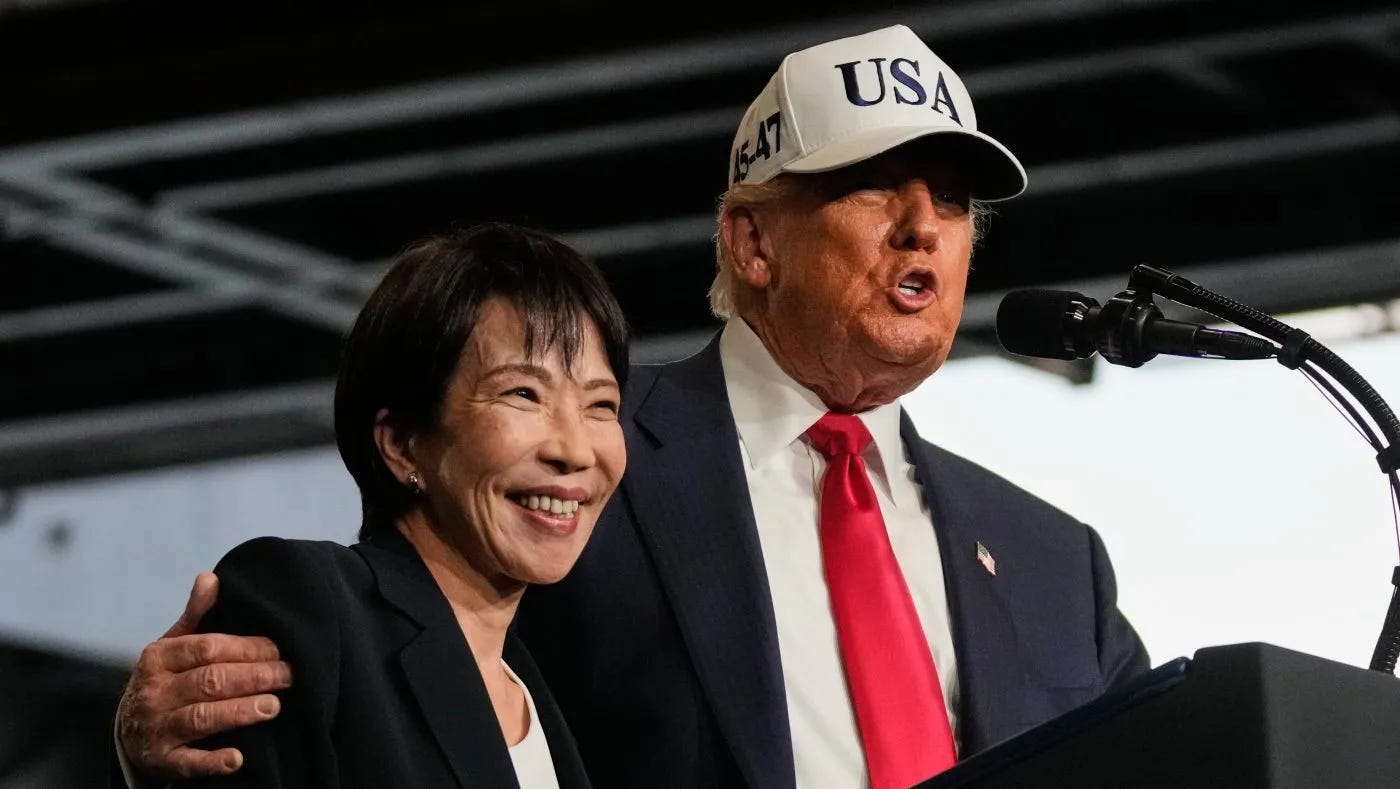
Observer Network columnist Yan Mo, part of the Guancha media group, wrote what many will consider a hawkish response to the victory by PM Takaichi’s Liberal Democratic Party in Japan’s snap legislative elections. That is related to a portion of his article’s title, ‘The great victory of “military rejuvenation” is a godsend opportunity for China to point to “US-Japan security,”’ while the second phrase relates to what he opines China’s response should be, which will become clear when reading his words. We haven’t seen his POV here at the Gym before, which has consisted of the Chinese government’s seemingly reasonable mostly dovish responses to the provocations made by Takaichi since her elevation to Prime Minister.
Before we get into the article, there’s one aspect of what Takaichi recently said just prior to the election when touring Japan’s North about wanting to finally attain a peace settlement with Russia over WW2. Russia has repeatedly stated it will not agree to a treaty for two reasons: Japan’s lack of sovereignty, which is directly related to it being occupied by the Outlaw US Empire which has stationed missiles targeting Russia that Japan has no control over. In other words, if Japan wants a peace treaty with Russia, it will need to end the occupation by the Empire and have the missiles removed. IMO, Russia will also require Japan to not modify in any way its Peace Constitution, which is what Takaichi’s party wants to amend so it can become militaristic again. I’m certain Xi and Putin discussed the Japan situation during their recent videoconference, and their policy will be totally coordinated. I should also add that Lavrov has said the spirit of Anchorage is kaput, which will be the focus of my next article. Now for this different Chinese policy POV:
The results of the Japanese election were announced, and the Liberal Democratic Party won a big victory, with more than two-thirds (316 seats) and a total of 350 seats in the ruling coalition. Although the “Takaichi Party” does not have a majority in the Senate, the overwhelming seat advantage in the House of Representatives is a key step towards Japan’s constitutional amendment and military rejuvenation.
The Japanese militaristic gangs were overjoyed, the United States snickered, and China was happy, and this election can be described as a win-win. However, who will have the last laugh in China, the United States and Japan depends almost entirely on our choice. Personally, I believe that this is a godsend opportunity for China to point to “US-Japan security”.
On the evening of the 8th, before the polls were opened, Takaichi, who was in high spirits, said in an interview, “We are trying to create an environment where we can visit Yasukuni Shrine” ...... “We will get the right understanding from our allies and neighbors.”
I don’t plan to analyze the election, because this result makes the process no longer important, no matter what reason the Japanese public opinion is highly in favor of Takaichi, according to historical experience, they will be the origin and vote for the revival of the military state.
Let’s start with “American snickering”.
There are signs that “China and the United States will eventually go to war” is the testimony of Trump and his decision-making circles, and all the current actions of the United States are aimed at “accumulating grain and slowly becoming king”, selectively retreating to later advance, and fighting for time for rejuvenation, so as to fight a war with China if/when necessary. And for the Japanese right, such a dedication means the greatest opportunity for Japan’s military revival after World War II.
The so-called signs mainly come from several arguments in support of the new version of the U.S. National Security Strategy (NSS), such as former Assistant Secretary of State A. Wes Mitchell’s article on the Foreign Policy website--”The Grand Strategy Behind Trump’s Foreign Policy”. [Non-paywall URL], Mitchell was Trump’s assistant secretary of state in his first term. This public stance is favored by the popular Elbridge Colby (now Deputy Secretary for Policy at the War Department) who co-founded the Grand Strategy Think Tank in 2019.
In short, Mitchell strongly supported Trump’s NSS and bluntly said that the new version of the NSS is a traditional “consolidation strategy” of the United States, which aims to preserve strength on the basis of reality and to prepare to fight China if necessary. Mitchell pointed out that the “consolidation strategy” was originally a grand strategy pursued by the United States for a long time, but after the end of the Cold War, the United States changed to expansionism, delusional to transform the world, and did not measure its own strength, so that it fell into the current predicament. What Trump is doing now is intended to replicate the successful model of the United States in the past.
“Guangji grain” is manifested in reindustrialization, restructuring supply chains, deregulation of the economy, energy production, and maintaining the dominance of new technologies. Mitchell described the part of “slowly claiming the king” more subtly, but compared with other similar think tanks, it is actually a tactical attempt to “divide the world into three parts”.
Mitchell means that Trump is committed to American rejuvenation, and his strategic logic is very concise—break first and then stand.
When it comes to “dividing the world into three parts”, many people disagree, believing that the United States will not let it at all, and it is impossible to divide the world and share the world with China and Russia. Furthermore, some people judge that the NSS focuses on “returning to the first island chain”, not “returning to the second island chain”, and the overall orientation is more offensive than contraction.
From a strategic point of view, the above statement is correct, but not detailed enough, from a tactical point of view—not to discuss Russia and Eastern Europe—the United States has shown a “transactional” posture towards China precisely to comply with its strategic purpose of “holding on”. It should be noted that the “consolidation strategy” requires the United States to avoid China’s edge in order to buy time for rejuvenation, but it must accelerate the absorption of resources on other “battlefields” to deal with the situation that “China and the United States will eventually have to fight”.
Therefore, it can be said that the “three parts of the world” is a tactical concession, a strategic offensive, and a retreat to advance, which is of practical significance to the United States, but it is not a fake issue, nor is it just a temporary hype.
Personally, I believe that China’s rejection of this concept is not the best policy, but should be calculated and crack the US delaying tactics in the region through military aggressive tactics at its doorstep. In the vernacular, Taiwan, Ryukyu (including the Diaoyu Islands), and even the South China Sea islands, should launch limited military operations as a bargaining chip for us to respond to the US attacks on China’s interests in South America, Europe, Oceania and other regions.
Considering the current situation in Japan, it is the best tactical choice to challenge the security of the United States and Japan by biting the “militaristic restoration”. Of course, against Japan, there are economic, trade, technical and other tools in our toolbox that can be used together, but military options cannot be avoided.
In any case, our tactic is to settle the general account with Japan, which can be extended to the Ryukyu and Taiwan issues.
Challenging the US-Japan security alliance is tantamount to forcing the US to defend Japan. Yes, dragging the US into this is the tactical objective. Without this, it’s impossible to counter the US’s overt strategy of expanding its core interests globally while simultaneously harming China’s overseas interests. Trump uses indirect tactics in East Asia; we should confront him directly, taking the opportunity to clear up issues on our doorstep, thus disrupting his efforts to seize resources in the Western Hemisphere and destabilizing his grand strategy.
In fact, in every incident where the US instigates its allies to cause trouble, we should primarily target the US, and only secondarily the offending ally. This simplifies the problem and the methods employed.
Forcing the US and Japan to join forces may seem like a foolish move at first glance, but don’t forget, time is crucial. Faced with our offensive, Trump must make a difficult choice between “buying time to rebuild America” and “defending Japan.” If he waits until America is rebuilt before taking action, it will be too late.
Avoiding pitfalls is a mistake. Binding our main adversary to ourselves prevents them from digging pitfalls; this is the fundamental solution. This was originally a major characteristic of China’s foreign strategy, but the fact that our adversaries are still diligently digging traps indicates that we haven’t quite mastered this tactic. In plain terms, mere “economic and trade ties” are far from sufficient; we cannot continue to shy away from using military means.
Admittedly, Trump’s term has less than three years remaining, but there’s also the scenario where he becomes a de facto ruler after 2028, continuing his unfinished grand strategy. Before then, the US is buying time to accumulate resources, presenting a window of opportunity for our offensive. The antics of the Japanese right wing provide justification for our attack.
The key point is that the US and Japan are currently at China’s doorstep with no chance of victory, and we have no reason to sit idly by and wait for the US to arm Japan, increasing its chances of success.
In the past, we emphasized “seeking progress while maintaining stability.” From this year onward, we might as well change it to “seeking stability while advancing,” considering various offensive or feint attacks to stabilize the situation and control the strategic pace.
Having understood the US strategy and tactics, let’s discuss the opportunities for the Japanese right wing.
Since Takaishi’s reckless statement last November that “something might happen to Taiwan,” I have been unable to ignore the pro-mainland rhetoric in Taiwan and the repeated emphasis by some mainland media outlets on “the US abandoning Japan.” I strongly disagree with this and have repeatedly pointed out that the reality is likely quite the opposite.
If Trump and his decision-making team believe that “a war between the US and China is inevitable,” then Japan is the most important pawn. During the US’s “stockpiling” phase, Japan serves to harass China, and even, as regional tensions escalate, it bears the responsibility of weakening China through quasi-military means.
Therefore, Trump’s temporary “cold shoulder” towards Takaishi is merely a show for China; it’s a typical double act, aimed at using Japan as a buffer or catalyst in the US-China confrontation. Simply put, Japan is the most important anti-China “material” in the US’s hands, beneficial to the US’s current “stockpiling” strategy.
Furthermore, Trump’s support for Takaishi’s team on the eve of the Japanese election, seeing their strong performance, suggests that Takaishi’s decision to hold an early election was correct. It also demonstrates Japan’s deep understanding of US strategic adjustments and Trump’s personality. The rise and resurgence of right-wing conservatives is the “pan-Western shift” Trump desires, from Europe to South America and East Asia.
The US’s support for the rise and resurgence of right-wing conservatives confirms the fundamental logic of its global ambitions and its strategy towards China. In other words, the current US not only won’t “abandon” Japan, but is actually a major supporter of the Japanese right wing and militarism’s return to the Asia-Pacific region.
Takashi’s historic victory in this election is more beneficial to the US than ten Marcos Jr.s.
So, will Trump worry about a backlash from militarism? Of course not, because he is simultaneously plundering the resources of these countries, ensuring that his allies remain allies forever—the exact opposite of the US’s past appeasement strategy, and this has been objectively verified—the right wing, for the sake of its revival, is willingly kneeling to pay the price for Trump’s extortion.
Therefore, we cannot overestimate the Japanese people’s desire for peace, because the country’s politicians are among the best in the world at controlling public opinion. It should be noted that this nation has a particularly pronounced herd mentality, believes in the logic of the strong, and is easily swayed by elites.
Although some Japanese observers have pointed out that the focus of this election was on economic orientation, and the political demands of “security orientation” were marginalized, these observers also emphasized that the election results could produce a kind of “institutional” rather than “non-mobilization” authorization. In plain terms, it involves using economic issues to entice voters to support Japan, then forcefully imposing non-popular defense policies, circumventing this by secretly revising Japan’s three key security documents, and unleashing the behemoth of militarism.
Attributing internal economic difficulties to external challenges is the cornerstone of the global conservative right wing. Trump exemplifies this, as do those he supports, such as Hungarian Prime Minister Viktor Orbán, former Brazilian President Jair Bolsonaro, Argentine President Michel Milley, and even Japanese Prime Minister Sanae Takaichi. This characteristic is precisely the main reason for the first rise of Japanese militarism in modern times.
The more severe the illness, the stronger the desire to take a gamble. The conservatives often conclude that war is the solution to the country’s structural ills.
Japanese scholar Yoko Kato’s book, Why the Japanese Chose War, explains that one of the main reasons is that Japanese farmers suffered losses in the political landscape after the Meiji Restoration, and the tax increases following the First Sino-Japanese War to fund the Russo-Japanese War further exacerbated rural poverty. Following the Great Depression of 1929, widespread farmer bankruptcy and insufficient government relief led to a shift in support towards the military, which championed the “Down with Anglo-American Capitalism” and the “Greater East Asia Co-Prosperity Sphere.”
Currently, Japanese farmers are suffering from cost pressures due to the Liberal Democratic Party government’s efforts to suppress inflation by lowering rice prices, resulting in widespread discontent. While this situation initially benefited the anti-right-wing opposition alliance, the opposition’s moderate appeals and electoral strategies proved ineffective, leading to their crushing defeat. Farmers’ resentment will likely be channeled by the right wing towards external challenges; previously it was “Down with Anglo-American Capitalism,” but in the future, it may be “Down with Chinese Military and Economic Oppression.”
Yoko Kato concludes that under the dual pressures of a sense of security crisis and internal economic hardship, “war is the only way out” has become a consensus between the ruling and opposition parties. The current situation in Japan is characterized by a “security crisis” stemming from right-wing hype about a potential “Taiwan crisis,” and economic hardship arising from the precarious balance between fiscal expansion and monetary normalization. Coupled with American resource plunder, the Japanese right wing has no choice but to return to militarism, amplifying external conflicts to offset internal crises.
Unlike the first wave of militarism, this time Japan is far weaker than its perceived adversary, China. Therefore, it must rely on the United States, seeking loopholes in US-Japan and US-China relations to achieve its goals. I have previously stated that Japan’s current strength is insufficient to revive militarism, but with US support, it is more than capable of being a stumbling block to China’s development. On this point, the US will undoubtedly provide support.
In other words, the US, feigning neutrality between the two sides of the Taiwan Strait while secretly supporting “Taiwan independence,” also applies to Japan. The US will feign neutrality between China and Japan while secretly supporting Japanese militarism. The key point is that Japan is not like Taiwan, which can at most play the role of a “porcupine”; Japan is perfectly capable of serving as a “vanguard” for the US in military and economic matters.
In conclusion, we cannot expect the US to agree to our revival of the narrative framework of the “post-WWII anti-fascist” camp, because Trump’s strategic characteristic is “destruction before construction.” The post-WWII order is precisely the failed narrative he wants to dismantle, a sentiment that absolutely benefits the Japanese right wing. [My Emphasis]
IMO, the author correctly pegs Trump’s policy goals and aims to attain them. His suggestion that China become aggressive, wich is similar to Japan’s strategy in 1941 to attack the Outlaw US Empire before it becomes overwhelmingly strong. But then today’s China isn’t 1941 Japan and is more powerful than the 1945 Empire, and arguably more powerful today in all respects except for the number of nuclear warheads. The problem with more overt aggression is it goes against China’s policy to push for peace, which is what its trading partners all prefer. China has said it does not intend to become a hegemon, but its actions must reflect those words to reassure its partners. The Trump Gang want to destroy anything that prevents them from doing whatever they want, and the biggest impediment in the UN Charter and the UN itself. It should also be noted that the Trump Gang is also feigning destroying NATO of which it’s the head. Lavrov today essentially admitted that what “spirit” seemed to emerge from the Anchorage Summit is no longer breathing, and part of that is the Outlaw US Empire’s continuing use of NATO to aid Ukraine, particularly its ISR capabilities. Russia will now need or perhaps has already reassessed its policy not so much in Ukraine but toward the Trump Gang, and that ought to favor China
The stated goal of Russia/China is to eliminate the Outlaw US Empire has global hegemon without nuclear war occurring. As Lavrov admitted today, that’s become harder because the Trump Gang still promotes what Lavrov termed “Bidenism,” which is essentially a continued Cold War that never really ceased. When we look at Russia since 1990, it’s retreated then advanced and has become very powerful. That’s what the Trump Gang would like to accomplish, which is why the author sees the next few years as a window of opportunity to act and push the Empire back to the second island arc (Guam, Australia), the first being Japan including Ryukyus, Taiwan and Philippines. The Empire still possesses a modicum of force projection that’s much weaker than 20 years ago, although its Navy borders on obsolete; even its vaunted submarine force has below average readiness standards. We see Russia and China acting in tandem to support Iran in its simmering war with the Empire and its Zionist proxy. How might that be employed against Japan? It was observed by an analyst that Trump wants to refight WW2, with a somewhat different order of battle that essentially is NATO against Russia and China.
*
*
*
Like what you’ve been reading at Karlof1’s Substack? Then please consider subscribing and choosing to make a monthly/yearly pledge to enable my efforts in this challenging realm. Thank You!
What is left completely unmentioned here and is almost never mentioned by foreign affairs "analysts" is the US' growing domestic economy weaknesses. Unemployment and poverty are rising and US domestic economic statistics do not reflect this because they are mostly fraudulent propaganda. NONE of the US' hyper-aggressive foreign policy actions have done anything for 95 percent of Americans, while risking REAL war that most young Americans are not willing to fight. Domestically, the US is sinking into second and third world status.
Excellent article.
I keep banging on about the need for Russia and China to formally announce a military alliance. It is needed to give other countries an alternative. Also its now past time to worry about India's position, I think Lavrov's comments are clearly made without the hindrance of keeping 'others' happy.
Iran has to be supported and openly.