

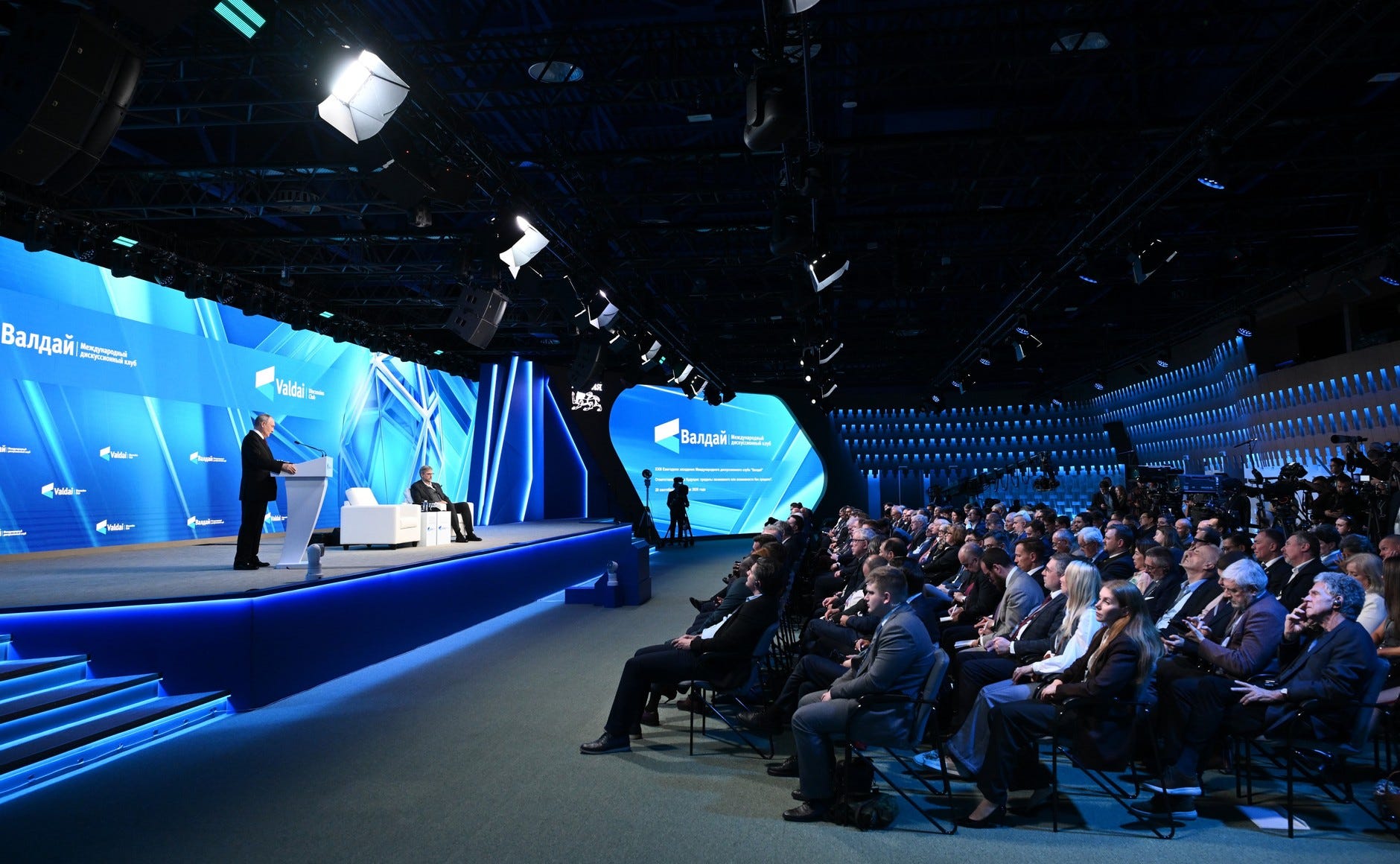
Another annual round—the 23rd—of Valdai International Discussion Club Forum has transpired with President Putin capping the show as usual. Lavrov was the star a few days earlier, but the transcript of his performance was very hard to find, although it finally surfaced at the Guancha website and must be translated from Chinese: “How Russia Responds to ‘What Can Be Done Without the West’?” There are several other events and materials that ought to be shared with the Gym, but Putin’s speech and the ensuing discussion currently outrank them in importance. This year’s topic is “Responsibility for the Future: Limits of the Possible or Unlimited Opportunities?” The Q&A Discussion portion is longer than Putin’s speech and will be reported in Part Two. Putin’s speech follows:
F. Lukyanov: Dear friends! Dear guests!
I am pleased to welcome you to the plenary session of the 23rd annual forum of the Valdai International Discussion Club. I am pleased to invite the President of the Russian Federation, Vladimir Vladimirovich Putin, to the hall.
Vladimir Vladimirovich, hello!
We are very glad that, as in previous years, you have again found the time and opportunity to meet with us.
The Valdai meetings are, of course, always intense. But, apparently, in line with what is happening in the world, the intensity and depth are growing, as is the mood — it’s becoming more uplifting, if you will, in a gentle sense.
This year, if we try to identify the key concepts of that meeting, that forum that took place over the previous three days, I would say that they are: change — it’s clear that we all see that changes are happening in virtually every sphere of human activity; responsibility, because the more change there is, the less clear the understanding of future development becomes, and the higher the responsibility of everyone for that development; and the third concept, which may seem surprising — and we also had quite intense discussions on this point — is the concept of calm.
Our report, which we prepare annually, is titled “Without Panic” this year. We suggest that in these difficult circumstances, we should avoid doing the wrong thing—that is, not to make a fuss.
I think you, with your position, have a better idea of which international concepts are the most important right now, so I would be glad to invite you to speak.
V. Putin: Ladies and gentlemen! Colleagues!
By a long‑standing tradition, we gather at the annual forum of the Valdai International Discussion Club to discuss the most pressing global issues.
We have always tried not only to diagnose the state of the world but also to outline the contours of the emerging world order.
I am convinced that the intellectual heritage and the experience of direct and trust‑based communication accumulated by the club will certainly be in demand when, sooner or later, all of us — East and West, North and South — will have to agree on the principles for shaping a new world order capable of ensuring the progress and development of humanity in the coming decades.
Unfortunately, we have to admit that today we are faced with other challenges, far more urgent and pressing. Although the host said that we need to reassure everyone, the pressing problems haven’t gone away — they’re still there.
The alarming trends we are observing on the international stage force us to think not primarily about how to organize global cooperation in the coming period in a more sensible, effective, and fairer way — although all of this is undoubtedly extremely important — but rather about how to preserve global peace and security right now, in conditions where many previous legal norms have been discarded and no new ones have emerged yet.
What needs to be done to avoid the most catastrophic scenarios? Responsibility for our common future is not an abstract slogan. It is a set of practical actions aimed at preventing humanity from sliding to the brink of survival and avoiding the irreparable.
The world has reached a decisive, turning point in its development. And it’s not just about politics — politics, as always, is a derivative of profound changes. Changes are taking place in all areas: from virtually any technologies to the social structure of societies, from climate to medicine, from military affairs to bioethics, from issues related to the future of energy to demographic changes, from universal digitalization and artificial intelligence to entirely new models of economic development — the list goes on for a long time. Taken together, this creates the conditions for a qualitative transformation. We cannot yet assess all its circumstances and their consequences unequivocally and in full, if only because the listed changes are unfolding simultaneously, and their impact on societies and states is contradictory. But I will mention this again.
The scale of the changes that have already taken place and those that are yet to come is simply enormous, and we seem to understand this; it’s no coincidence that there are so many debates about the future right now, often with a clearly pronounced undertone of anxiety due to the uncertainty and unpredictability. But although humanity is experiencing major changes, it has not yet truly fully grasped the magnitude of the challenge it is facing. This is the beginning of a completely new, absolutely new reality. Threats and dangers are closely intertwined with opportunities and prospects, and they are inseparable from each other. Our entire lives are changing.
Let me emphasize once again: this is not just about, or even primarily about, a shift in the balance of power between states or a redistribution of economic and technological influence – all of that is important and certainly matters. But the main point is that the changes affect the biological and moral nature of human beings, their essence, the way we exist, and the foundations of our worldview. Technologies are opening up literally fantastic prospects for extending and improving the quality of life. However, they also take the potential for widespread destruction to a new level—unfortunately, as a result of military conflicts, rapid environmental degradation, or the loss of control over advanced technological processes.
It is clear that such an atmosphere cannot but cause increased nervousness among people and societies, and a rise in internal tension, which is linked to uncertainty and a lack of understanding of what the future will hold. One of the consequences is the internal political turmoil in many countries, especially since classical party systems are increasingly failing to reflect the rapidly changing social structure. For any state, no matter how it is structured and what [cultural and historical] traditions it relies on, internal stability — I think you will agree with me — is always more important than anything else, and in order to preserve it, governments may take a variety of actions, including those that affect the situation abroad, in neighboring countries, regions, and even in the world as a whole — in other words, unfortunately, they export instability. All of this only exacerbates and intensifies the tension, so to speak, the intensity of the international environment.
Regardless of what scenario unfolds in the world in the coming years, the continuation of international conflicts is, unfortunately, quite likely. This is particularly true because the ongoing fundamental shifts and the opportunities they create are stimulating and fueling ambitions and a willingness to take risks in pursuit of what seems to be a major gain. I would like to be wrong about this assessment, but, unfortunately, the persistent trends of today are precisely as described.
However, we are confident that, in the long term, as the world moves away from Western hegemony, the global situation will gradually improve, moving towards a more stable, democratic, and free multipolar international order. However, it is also clear that on the path to such a world order, we will face various risks for states, communities, and each individual. In the context of fundamental shifts, this is inevitable, which is why minimizing risks at any level — from the global to the personal — is today the main task for those responsible for making decisions in politics, business, science, and in life in general. A lot depends on these people. The responsibility also lies in helping people to recognize such risks and be prepared for them, so that a person or a family is not left alone to face problems in the area of security, in the changing labor market, in the digital space, and so on.
What, in my opinion, is very important right now? Caution and prudence to avoid being caught in an avalanche of uncontrollable changes? Or an active, assertive approach aimed at overcoming unfavorable scenarios or using circumstances to one’s own advantage? There is no specific [universal] answer here; in each case, a different course of action is advisable.
People who make decisions, of course, try to adapt to what is happening. But in the context of what is now being called a polycrisis — a comprehensive and widespread one — it is objectively very difficult for them to break away from the daily management crisis and look ahead, beyond it. The current responsibility is enormous; a mistake can be very costly, including for the future. Today’s tasks often push strategic goals into the background. This is, of course, understandable, but it is very, extremely dangerous. It is impossible to address many of the current challenges without taking into account how our actions today will affect our future. As one well‑known classic of Russian political thought put it, one cannot see the forest for the trees.
So, what does the overall picture look like? It is clear that the mechanisms for coordinating the interests and actions of states, which were created in previous periods, are no longer capable of fully and effectively performing their regulatory function. This is not because they are bad, but because the conditions in which and for which they were originally created have changed. The emerging new reality will, of course, contribute to the creation of new tools, but this is a very long process. To be frank, some international organizations today often do not reduce risks; instead, they sometimes create and provoke them, serving the interests of one country or a group of countries. But that’s not what they were created for.
Criticism is also directed at such a fundamental structure as the United Nations, which, in accordance with its Charter, is intended to play the role of a central coordinating mechanism in world affairs. This criticism is certainly not always objective, but there are also well‑founded concerns. Partly, they stem from the fact that the UN — although it is the most representative global organization — is in fact governed in a much less collegial and democratic manner than was originally intended. A limited group of Western countries exerts disproportionately great influence, and, being an obvious global minority, it seeks to usurp the functions of governance. And as the real influence of these states is declining in favor of an increasingly independent and self‑confident global majority, the imbalances in the UN system are becoming ever more pronounced. This is a systemic problem that cannot be solved overnight.
Russia has consistently supported the idea of a fair reform of the United Nations, both before and now, but this reform is impossible without internal consensus, which is currently difficult to achieve. Let me repeat: we consistently advocate for the UN structure to reflect the full diversity of the world, so that countries in Asia, Africa, Latin America, and the Middle East play a much more significant role in the organization. At the same time, it is important to bear in mind that the transformation of the UN is by no means limited to expanding the Security Council and other measures aimed at achieving a more balanced geographical representation of countries in international governance bodies; it also involves a new content and focus of the organization’s work, as well as priority areas of its activities, including future‑oriented ones — especially since global changes are creating a great many new dilemmas that simply did not exist before.
The most obvious example is the question of artificial intelligence, which we will all have to learn to live and work with. How will its rapid development affect the intellectual level of humanity itself, as well as its spiritual and cultural heritage? It is no coincidence that the concept of “careful digitalization” is being discussed — that is, the rejection of uncontrolled implementation of such technologies in areas that have always remained important and sensitive to the moral development of a person. And the socio‑humanitarian aspects of the spread of artificial intelligence are now being analysed even more closely and thoroughly than the technical or economic ones. Experts are increasingly saying with concern that the spread of artificial intelligence may become yet another attempt to bring everyone to a common denominator, to depersonalization – now through the use of algorithms that have been set up by someone. Such digital totalitarianism will be just as dead‑end, gloomy, and inhumane as the examples of totalitarian societies from the past that we are familiar with.
And another significant question – it is relevant today and will become even more pressing in the near future – is this: how can states that are transitioning to an increasingly digitalized foundation ensure sovereignty in this area? That is, how can they guarantee their security and distinct identity without isolating themselves from global progress and without falling behind in technological development.
Another area in which science and technology are fundamentally changing the world is humanity’s ability to deeply interfere in what was previously considered the prerogatives of the Creator: genetic changes to the body, influence on the formation of personality, programming human behavior, and even the way of thinking. It is necessary to unite the efforts of countries and communities in order to jointly seek solutions that are acceptable to everyone for these extremely delicate, defining, and truly existential questions of existence.
It would be logical to carry out such work within the framework of international organizations. However, as already noted, many of them are subject to the excessive influence of Western countries, which are not interested in universal progress but only in preserving their own power. [IMO, that phrase cannot be emphasized enough.] The institutions that were effective after World War II do not reflect the situation in the second quarter of the current century. Is it possible to reform them effectively so that they correspond to modern realities? The question remains open.
New international communities are also emerging, generated by the current global situation. They certainly have great prospects, whether they are various regional associations or already global structures such as the BRICS. However, we must admit that they all have a lot of work ahead of them to determine their functionality, the optimal areas of its application, and the limits of their own capabilities. It would certainly be unreasonable to expect relatively recently established structures to quickly reshape the world around them and establish a multipolar model. This is a long and thorny path with many unknowns, but it will undoubtedly lead to results.
Does this mean that we are currently doomed to chaos? No, it would certainly be premature to make such a verdict. In general, a world regulated by clearly defined norms and regulatory institutions — a world that can be described as orderly, if we may put it that way — is a relatively recent invention, dating back to the last century. All previous centuries managed without it. As we know, the results were, to put it mildly, varied: arrogance, envy, and greed have always been present in world politics, and they still are.
Nevertheless, responsible powers have always, in one way or another, competed, but they have also worked together, designed, and built systems of relations among themselves and with other, smaller states, and, on the whole, generally sought to maintain stability. [IMO, many will argue general stability remains elusive for the very reason Putin stated above and bolded in red.]
Currently, against the backdrop of a crisis of institutions and the degradation of international law, major powers bear enormous responsibility commensurate with their own vast capabilities. Such states have the potential to take actions that could instantly change global trends toward greater predictability and security—or, conversely, toward deepening, exacerbating, and collapsing all problems. This potential multiplies manifold thanks to the new technologies already mentioned, and it is clear that the future of the entire world—and, consequently, of every individual—depends on how effectively risks are managed during a period of abrupt change.
The absence of universally accepted rules, a clear understanding of the principle of equal and indivisible security, or the abandonment of this principle often leads to selfish behavior, and in some cases, it turns into aggressive attempts to gain unilateral advantages, exacerbate the confusion, and exploit it for one’s own benefit. World politics provides examples of this almost every day. All conceivable and inconceivable taboos are being violated — I won’t list them all now; I think those in the room understand this perfectly well. I am deeply convinced that such a complex area as international relations nevertheless requires care and adherence not only to established laws but also, as lawyers say, to customary law — that is, not only the letter but also the spirit of the law, as well as established and universally recognized practice.
Moral and ethical constraints and propriety are still important, because respecting them creates the possibility of at least some kind of dialogue. Conversely, the systematic failure to fulfill obligations, deception, the transformation of communication into a farce, any substantive conversation into propaganda, the demonstrative mockery of facts and their inversion for the sake of short‑term gain destroys the very foundation of international coexistence.
This kind of, if I may say so, practice of conducting international affairs is short‑sighted and dangerous. The temporary gain obtained in this way may turn into long‑term failures, and, most importantly, it will worsen the situation for everyone, because the interconnectedness of the world is here to stay. The principle “power is enough” sometimes seems to be the guiding principle for some international players who are confident in their own military‑political, economic, and, as they believe, moral superiority. We know very well from history that this never ends well.
Let me take a brief detour from the main topic. There are people here with very different viewpoints on the very acute current conflict, the Ukrainian conflict, and its causes. I would like to say a few words about this. Yes, and many hundreds or even thousands of experts — your colleagues who will be studying the materials from the current Valdai Club meeting — also have their own thoughts on this matter. I know, of course, that some members of the expert community will have a question: Russia talks about peace, yet it started the war. I have already expressed my views on this many times. I’ll say it again in such a gathering.
Where is the truth? The truth is that it wasn’t us who wanted it, and it wasn’t us who started the war — they started the war against us. We shouldn’t have been encouraging aggressive nationalism and Russophobia in Ukraine for years, with the aim of turning it into a tool to fight Russia. NATO shouldn’t have started militarily exploiting our historical territories in the interests of the organization itself, or planning to set up its bases there. We shouldn’t have been pushing radicals in Kyiv towards a coup d’état, and then pumping the regime that was effectively created in this way with a wide variety of offensive weapons. There was no need to draw up plans for organizing concentration camps for the residents of Donbas and Crimea. There was no need to crush them with tanks, bomb them with missiles, shoot them from aircraft, and burn unarmed people alive simply because they are Russian by nationality and spirit.
There are many more such “don’t” statements, but I’ll stop here. I’m sure that Russia was deliberately put in a situation where it was simply forced — in response to this obvious aggression — to defend itself with weapons in hand. We were deliberately pushed to this point. And in general, we shouldn’t turn Russophobia, the oppression and murder of Russian people, and the destruction of Russia into a state ideology and set ourselves the goal of strategically defeating Russia. That’s exactly what it sounded like, isn’t it? No one has forgotten that. We, at any rate, don’t forget.
If we want to live — and everyone wants to live — then, as I once said in a public speech, let’s live in harmony and together look for ways to make that happen. And building trust, of course, is a complex and fragile process; it’s very difficult to establish and very easy to destroy.
The interests of even the closest partners cannot fully align. What can we say about countries that are in a relationship of rivalry, fierce competition, and even more so, confrontation?
Sooner or later, the international situation and the system will reach some kind of stable balance. Undoubtedly, this is a complex, multifaceted, multi‑layered process that requires mutual compromises, moving towards each other, and a sober assessment of the situation, including on the part of the West. The former hegemon will inevitably have to acknowledge the realities of a multipolar world — this is inevitable; just look at the trends in the development of the global economy — and will need to learn to cooperate with the countries of the global majority on the basis of respect for their fundamental interests. This, of course, will not happen quickly. We are about to live in an extremely unstable, changeable world. The path to a new system will be replete with unexpected twists and turns—unfortunately, often unpleasant and even dangerous.
And here I would like to turn to our own, national history. Russia has gone through a difficult path of fundamental transformations, and this process is ongoing. Thirty‑five years ago, we experienced the collapse of the state system, which became a real tragedy for tens of millions of people who, overnight, found themselves “abroad,” and this changed their fate, the fate of their children. Both in Russia and in neighboring countries, all this led to a fundamental transformation, and it also had an impact on world affairs.
I would like to single out a certain naivety, idealism, and perhaps even carelessness on the part of those who were at the head of the state in the final years of the Soviet era. Blind trust in Western partners, the belief in the possibility of certain “gentleman’s agreements,” where it was supposedly enough to take someone at their word and reach an agreement on something — this is what also played a cruel trick on the Soviet Union.
In retrospect, it becomes clear how destructive a role this played not only in the fate of the USSR but also in ensuring long‑term global stability. Soviet leaders wanted to win over the West, while Western leaders sought to reshape the world to suit their own interests and to seize their share — preferably a large one — of the Soviet legacy. We can see the result.
The collapse of the USSR was the result of a combination of accumulated internal imbalances; first and foremost, this needs to be acknowledged—it’s true, that’s how it is. It was precisely the internal imbalances and mistakes made by more than one generation of the country’s leadership that undermined the USSR’s internal and international standing, step by step. And ultimately, they led to its collapse.
What is happening in the world today, the current conflicts and upheavals, are largely the result of the unwillingness, unpreparedness, or inability of politicians at the end of the 20th century — both in the East and in the West — to take a serious and profound approach to the era of grand changes. And this is not shifting responsibility onto past leaders; it is reality.
But even in that time, which now seems so distant from us, there were other people, other politicians, both in the East and in the West, who deeply understood the problems and, in my opinion, proposed the right ways to solve them. Their assessments can be called prophetic today.
You know, I’ve already mentioned publicly a couple of times such a political figure in the FRG as Egon Bahr. He was a member of the board presidium of the Social Democratic Party of Germany.
I’ll give you just a few examples. You know, when I read about his contacts with the Soviet leadership, both in Bonn and in Moscow, I was simply surprised — surprised at how substantive, intelligent, and well‑educated this man was.
I will give you some of his statements made in June and February 1990 — as we understand it, at a turning point for the fate of Europe and the entire world.
What concerned Mr. Bahr the most was the threat of the confrontation persisting in Europe after the unification of Germany and the strengthening of, and I quote, “the influence of those circles within NATO that are by no means eager to embark on the path of pan‑European cooperation and the winding down of the confrontation.” That’s his quote. He could see at the time that such circles existed. And he knew better, didn’t he? During the negotiations in 1990, Egon Bahr stated, and this is also a quote: “If decisive steps are not taken to overcome the division of Europe into hostile blocs, the development may take on a very unfavorable character, condemning the USSR to international isolation.” This is also his quote. And what was proposed? By the way, we can see that things turned out exactly as he had predicted and warned about.
What was proposed for Eastern and Central Europe? It was proposed to create a security council with the participation of both the USA and the USSR, and with broad powers. This council was to include virtually all of Eastern and Central Europe.
However, after the collapse of the USSR, it was precisely those very forces that, as Egon Bahr had said, were not eager to embark on the path of pan‑European cooperation that gained the upper hand in the West. Despite the many years — and I want to emphasize that it was indeed many years — of attempts by the new Russia to become part of the so‑called Western civilization, in practice they did everything they could to isolate and further undermine the Russian Federation itself, viewing it — despite all the internal political changes that had taken place in Russia — as a key part of the historical Russian Empire. And they still say this at various events and gatherings, to this day: we need to finish dismantling the empire.
All of this has led to the current, frankly speaking, very dangerous situation in Europe and the world.
I would like to draw your attention, ladies and gentlemen, to the fact that, in my deep conviction, Mr. Bahr was then thinking exclusively about the future of Europe, about that very pan‑European home that the leaders of the USSR talked about so much at the time — but, unfortunately, they limited themselves to mere words.
In Russia, perhaps better than in many other places, people know how difficult it is to overcome the consequences of historical collapses and cataclysms, to move forward blindly in new and often unfavorable circumstances. Often, they had to rely on trial and error, reacting to emerging situations as they arose.
But we never forget that a nation needs a perspective, needs to understand the direction of its path into the future. Without the past, of course, there is no future. The legacy of our ancestors, who built a great and unique country, must be preserved and strengthened. No society can exist without a historical foundation and respect for traditions. But the opposite is also true: without the future, the past loses its meaning. No matter how grand the achievements of our predecessors may be, we cannot turn into a museum of past greatness. The true greatness of a state is impossible without the ability to keep pace with the times, and ideally, to be ahead of them. The enrichment of its heritage and its creative development in relation to new conditions is the best guarantee that a national tradition will not turn into an antique, into a fashionable historical accessory, and will not remain solely the subject of our constant attention. We must focus on a living, fruitful environment for future achievements. [The two bolded sentences need to be seriously considered by my fellow Americans.]
As for the future, much is indeed shrouded in uncertainty, with too many rapidly emerging and rapidly changing factors. But a “roadmap” for the path to it is certainly necessary, and this is not a utopia, not abstract speculative constructs and detached design of desired images, but a realistic assessment of risks, opportunities, and necessary goals. Russia is building such a route to the future for itself and, of course, is ready to participate in this work together with other countries and peoples of the world.
Let me reiterate: the scale and, most importantly, the speed of the changes taking place in the world are unprecedented. And we must be aware that the moment when nothing can be changed may come very quickly and unexpectedly for everyone. It will simply turn out that the logic of escalating, harsh, mutual responses leads to fatal irreversibility.
Currently, in the context of describing and predicting various global conflicts, the word “escalation” is often used: the unwillingness to turn to genuine diplomacy, based on reality and taking into account the interests of all parties, pushes towards inflating the situation, raising the stakes, and often resorting to bluffing, crossing “red lines” in the hope of suppressing and intimidating the opponent, breaking them. Escalation of hostilities and sanctions is not a new practice; it has been used in many conflicts, and it is never unilateral: the provocative steps taken by some are met with a response from others. Thus, the spiral continues to spiral ever more tightly, and the destructive consequences grow.
At the heart of the escalation — and I’m not saying anything new — is arrogance and self‑confidence. This is a path to the edge of the abyss, especially today, when the arsenals of the world’s leading powers contain weapons capable of destroying all life or, at the very least, bringing Earth to a catastrophic state. Can we be sure that these weapons will never be used? Of course not. We all know the well‑known saying: if a gun is hanging on the wall somewhere on the stage at the beginning of the play, it must eventually fire. We need to keep this in mind and avoid it.
The more uncompromising the opposition, the more openly the goal of “strategic defeat” of the enemy is declared, the higher the chance that the battle will escalate to the most brutal phase. The laws of the struggle for survival apply not only in the natural world but also in social communities when they are faced with the prospect of losing their independence, dignity, and even the right to exist.
Dear Ladies and Gentlemen,
Let me repeat: the fundamental formation of a new world order is inevitable. Let’s hope that this will happen in the foreseeable historical perspective, but for now everything is happening too rapidly and spontaneously. We are only outlining, groping for the contours of the future.
But this, of course, does not mean that we should sit idly by and wait to see what happens next. To reach the phase of creation — which, as I’ve already said, will certainly come sooner or later — we need to get through the current dangerous moment and avoid the realization of the most destructive threats.
I believe it is particularly important to emphasize once again two aspects that, in my view, should become the subject of serious discussion for all of us at the political, technical, expert, and even philosophical levels.
First and foremost, this is a question that has already been raised — about artificial intelligence. Currently, a debate is unfolding around the world about whether measures should be taken to deliberately slow down research and development in this field and prevent technologies from getting out of human control. This is a very multifaceted topic that requires thorough consideration. Human history shows that it is impossible to stop technological progress, but we must understand the consequences of progress — and above all, in terms of how its achievements are used, including in the military sphere.
There are already cases when artificial intelligence makes its own decisions based on its own understanding of expediency. This applies to both civilian and military applications. As artificial intelligence technologies are further introduced, their role will increase, and algorithms will take on more and more responsibility. Moreover, a person, of course, cannot compete with the ability of a machine to analyze the situation almost instantly. But a person has other qualities – flair, intuition, the ability to make an unobvious, perhaps, decision, which turns out to be the only right one in the end and saving.
You know, I’d like to tell you a story from Soviet practice, from Soviet reality. September 1983. Lieutenant Colonel Stanislav Petrov was on combat duty and received a signal from the missile attack warning system. We, and the United States, have such systems, and they’ve been in operation for a long time. The system detected the launch of five American intercontinental ballistic missiles. Any algorithm would classify this as an unambiguous reason for a retaliatory strike. But the experienced officer doubted the accuracy of the signal, suspected a system failure – and he was right. If an artificial intelligence had been in his place, everything could have turned out quite differently. In my opinion, this is a very convincing example.
The limits of using artificial intelligence technologies in the field of security are a matter of humanity’s survival. Artificial intelligence contributes to increasing the effectiveness of combat tools, and this also leads to an increase in the destructiveness of conflicts.
An unbiased, professional international discussion is needed about the modern method of conducting armed conflict – how to preserve the humanitarian framework and limit the most brutal manifestations of armed conflicts associated with the growing destructive capabilities. I know that you held a session at your forum, the title of which seemed very apt: “The Ethics of the New War: Man and Inhumanity.”
Indeed, the inhumanity of modern conflicts can be understood in two ways. This includes growing brutality and disregard for humanitarian norms. These are also new forms of confrontation, when artificial intelligence and autonomous systems are playing an increasingly important role in the conduct of combat operations, gradually replacing humans, including in decision-making, which is especially important. This is a huge and complex topic that requires the most careful attention. The automation and digitalization of war lead to the dehumanization of perception, to the transformation of bloodshed and the loss of human life into a kind of computer game, into a mechanistic routine. And this, to call a spade a spade, is the path to the degradation of humanity, accompanied by talk of grand technological progress.
At some point, at the very end of the 19th century, in 1899, it was Russia that initiated the Hague Conference, at which the rules of warfare, the peaceful resolution of disputes, and the humanization of combat operations were first codified. Yes, of course, the sound and noble ideas put forward back then did not protect humanity from the upheavals of the 20th century. The world wars seemed to have nullified the achievements of humanitarian law. But now the time has come to raise the issue of the rules governing armed conflicts once again.
There are no illusions: wars have always existed throughout human history, and they still do, and most likely, armed conflicts will continue. Unfortunately, this is an integral part of humanity’s existence. Military service is a profession for people who defend the interests of their countries, but professionalism in the military sphere also means adhering to humanitarian norms. The Russian military, for example, has always been guided by the inviolability of these norms and, I want to emphasize this, has never been the first to attack objects that are not directly related to the enemy’s military infrastructure.
The rise in international tension and the escalation of the global confrontation have another very negative long‑term consequence, and this is the second most important factor I would like to draw your attention to today, namely: in the current conflict‑ridden atmosphere, a real solution to global problems affecting all of humanity has been sacrificed. These problems were constantly discussed not so long ago, but today they seem to have been somewhat forgotten: climate, ecology, poverty, inequality. They have been pushed aside now, but their urgency is only growing — they haven’t gone away. Unfortunately, there is no reason to hope that the international community as a whole will be capable of seriously addressing this agenda in the foreseeable future. But if pressing and urgent issues are not resolved globally, they need to be addressed at the regional level, especially since this is closer and more understandable to people.
We are all responsible for the planet as a whole, but above all for our own home and its immediate surroundings. Our home, in the broadest sense, is Eurasia — a vast territory, the center and the stage for most of the most important processes unfolding in the world. Much depends on how we manage to shape Eurasia, and this has far‑reaching implications for the entire international arena.
In the context of growing global instability, the idea of a large‑scale Eurasian partnership, which Russia put forward at the time, is acquiring particular significance. Military and political confrontations are undermining the interconnectedness of the world; production and transport and logistics chains, as well as established trade and communication routes, are under threat. The task and responsibility of Eurasian countries is to protect our space as much as possible from global risks and destructive processes, to use the emerging technological and other opportunities in order to qualitatively expand Eurasian cooperation and strengthen the connectivity of this vast territory.
I would also like to note that the cultural and civilizational communities represented in Eurasia have experience in finding ways to interact during the most difficult historical eras over many, many centuries. Eurasia has the potential to become a prototype of international communication in conditions of cultural heterogeneity, differing approaches, and interests, where differences become not an obstacle but an advantage for building a sustainable, balanced partnership.
In this regard, I would like to draw attention to the initiative we put forward together with our Belarusian friends regarding the development of the Eurasian Charter on Multipolarity and Diversity in the 21st Century. Last week, at a meeting of the foreign ministers of Russia, Belarus, Kazakhstan, Kyrgyzstan and our other partners, which took place on the sidelines of the UN General Assembly, practical work on this fundamental document was launched.
The value of Eurasia lies primarily in the fact that, to a large extent, it is self‑sufficient and capable of solving any problems. The only thing this vast community of nations needs is indivisible security, the absence of military threats, and lasting peace.
Dear colleagues!
We all, the entire global community, share a common responsibility for tomorrow. And this is not an exaggeration, not a metaphor; I repeat, this is an absolutely practical task that we need to address without delay.
I would like to believe that our descendants will be able to learn from future history textbooks that the second quarter of the XXI century was a turning point when humanity, realizing the scale of changes and challenges to its existence, found the strength to put aside squabbles, ambitions and selfishness and unite to solve common problems, turned the technological revolution from a set of threats to a wide a wide range of opportunities, began to solve the problems of social inequality and environmental degradation not in words, but in deeds, realized the futility of military confrontation and dictates and the need for an acceptable solution to emerging issues and problems, and finally began to build a new sustainable world order. I’m sure that’s exactly how it will be. Because if all of this doesn’t happen, there’s a risk that there will be no one left to study using these textbooks. And the textbooks themselves won’t even exist.
Let’s believe in the best, and most importantly, let’s do everything we can to make sure that this best comes true and is with us.
I would like to thank you for your attention and wish everyone success. I really appreciate our meetings. Thank you. Thank you very much. [My Emphasis]
And so ends Putin’s speech. The Q&A discussion portion is twice as long as the speech and will be provided in Part Two. As usual, Putin addressed both Russians and the entire world, but I doubt a certain group of Outlaws won’t bother to listen or read what he had to say, and that’s where the seat of global troubles lay. I have another term for Putin’s “selfishness”—Exceptionalism—and a term for those who have trashed the intentions of post-WW2 peacemakers—Outlaws. That both terms describe the Collective West and its two adjuncts—the Japanese and Zionists—are needed to provide a finer point to Putin’s diplomatic prose. The speech’s generalities will be questioned during the Q&A Discussion. Should Putin have said more, and if so what about? He knows more is to come. IMO, Putin must remain an optimist, although he shows some pessimism as his stark warning delivered in his conclusion shows. Trump wasn’t directly named but his behaviors were. Putin’s remark about what constitutes military professionalism was also aimed at the Collective West and the Zionists which have mostly degenerated into soulless ghouls—Both the Outlaw US Empire instigated wars on Ukraine and Iran are illegal aggressive wars so ALL orders given related to them are illegal and not to be obeyed.
*
*
*
It’s hard to ask for contributions given our current uncertain circumstances, but I must ask for them just the same. Please consider contributing when subscribing. Thanks very much for those who have in the past and do so now!
I recently wrote to a friend in Russia about two issues that also feature in Putin’s speech. At the moment, I’m not feeling particularly optimistic. I also disagree with Putin on the subject of the UN.
———
I have read your remarks. ... At the moment I am somewhat distracted by other activities that require my attention. .... But I can already agree with you fully and completely. .... But - there is a but. BRICS and whatever follows this alliance of states is still standing on very shaky and unstable footing. That will still take a very long time. .... And then there is the Shanghai Organization. The UN is dead and unreformable. In the long run, there will be a successor organization. Perhaps it will emerge from the Shanghai Organization. .... I know you do not share my point of view, but nevertheless I must repeat that the likelihood of a war between NATO and Russia in Europe is exorbitantly high. All of West Asia will change massively. Countries such as Israel, Jordan, Saudi Arabia, Kuwait, the UAE, Qatar, and Bahrain will disappear from the map. Syria will likely be dismembered. ... All this will accelerate if Israel and/or the USA were to use nuclear weapons.
When I look at today's so-called "Global South", I wish I could live for another 100 years. Perhaps I would then have the opportunity to witness the oligarchs, the corrupt elites, and organized crime being eliminated in these countries, and poverty eradicated. I can only believe it when I see it. But I won't live that long. So for me, the glass is half empty.
———
I think Russia wants to wear down the Kiev regime AND the Ukrainian urban populations. No heating, no electricity, no heating, no working toilet flushes, a shortage of food and drinking water, no gasoline, disrupted train connections, a collapsing healthcare system, and the resulting psychological attrition of the population. Winter under these conditions must be hell on earth. Hardly any way to transport ammunition, spare parts, diesel, and personnel to the front. Relentless pressure on demoralized Ukrainian soldiers, who would rather surrender to the Russian army than be killed by Nazi blocking detachments. Increasing partisan activity in the rear. This can only mean that:
1. The Ukrainian army is falling apart.
2. The civilian population is fleeing the cities on a massive scale, trying to escape to or via Poland into the EU. But Poland will close its borders.
3. Zelensky, the government, and parliament will flee from Kiev to Western Ukraine.
4. In the spring, when the ground has dried, Russian mechanized combat formations will once again be able to achieve faster territorial gains on a larger scale.
5. Then comes the most dangerous phase. Because then in the USA, either the small rational faction of the officer corps in the Pentagon will prevail, or the Deep State around the CIA, Wall Street, and the neoliberals. In the latter case, the USA would make the insane attempt, together with the European NATO vassals, to do something very stupid that will lead to the destruction of Europe.
As I once wrote to you regarding my point of view, as soon as the Ukrainian regime and its military collapse, the most dangerous phase of this war begins. Oh yes, Russia will annihilate any enemy. But under certain circumstances, that could also mean my own ass is at risk as collateral damage.
Let's hope the rationally minded generals in the USA do not obey any orders. Then NATO can do nothing.
Such thoughtful words, and they seem very sincere. I'd love to see words like this come out of the mouths of western leaders.