

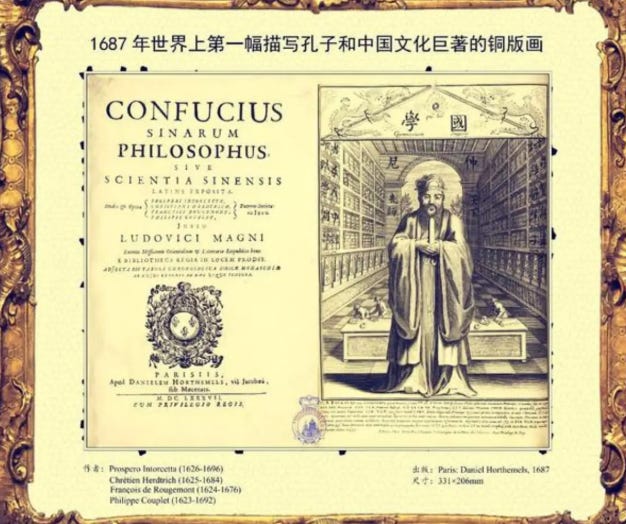
Note the publication date at upper left—1687.
When I saw the title of this Dragon TV, “This is China” production, I was very curious to learn what the distorted translation called The “Kaftin Canyon” of Western Political Civilization, which was made even harder when it was also called a “gorge”. At least there was a clue—the term was associated with Marx and one of his observations: “The Krafting Canyon” which referred to the shaping process a society undergoes when subjected to Capitalism that’s possible to avoid as I discovered thanks to Yandex. By the time I’d read far enough to answer my initial question I was fascinated by the history and interpretations being presented and determined that I ought to share this transcript with Gym readers. So, lets dive right in with the program’s preamble:
In China’s political civilization, bureaucracy is an organic part of the overall state system, serving a higher “political path.” But Western bureaucracy is more of a tool-based “technique,” extremely immature and prone to deviation or regression.
On July 13’s Dragon TV’s program “This Is China,” Professor Zhang Weiwei, Director of the Institute of China Studies at Fudan University, and Professor Fan Yongpeng, Deputy Director of the Institute of China Studies, observed the governance challenges of Western politics through the lens of Western bureaucratic systems.
Prior to the adoption of the Civil Service System within the USA, we had what was then called correctly The Spoils System where the election winner needed to replace all the previous people, which was somewhat easy when the federal government was small—spoils because lots of corruption occurred throughout the Federalist System (Federalism), which was the national system of governance, not just at the Federal level. Other Western nations have their own systems that citizens often curse without really knowing why. Hopefully a lesson lies in what follows:
Fan Yongpeng:
In recent years, various chaotic phenomena have emerged in Western political arenas, reflecting that Western political civilization is undergoing a serious crisis. Today, I will discuss the challenges faced by Western political civilization from a very specific perspective: the issues of the American bureaucratic system.
From recent news reports, we often hear about all sorts of bizarre phenomena exposed by the American bureaucratic system. In fact, it’s not just us “onlookers”—Americans themselves are anxious, with people constantly criticizing the government’s bureaucracy, inefficiency, and corruption. However, the U.S. government’s approach to solving problems is different from ours; its approach is very unconventional. They do not diagnose rationally or reform in an orderly manner.
For example, when Trump was first elected, he started harshly criticizing the bureaucratic system as a “deep state” because he couldn’t handle the bureaucratic machine, which is understandable. But in his second term, his approach became increasingly outrageous. First, he teamed up with Musk to carry out sweeping reforms, cutting many institutions they considered useless, laying off a large number of officials, and destroying many people’s iron rice bowls.
Then these two fell out on their own, and the “Government Efficiency Department” stopped doing it and directly treated the government as their personal attendant. The White House is full of nepotism, calling deer a horse, flattering, and singing praises, all about “winning the classics,” almost to make Trump a king.
After all this turmoil, America’s bureaucratic politics have become even more complex. Old problems remain unresolved, and new ones have emerged. In summary, I think there are currently several main symptoms.
First, the traditional principle of “civil official neutrality” has failed. Over the past few decades, many in the global political science community have promoted a core value of the Western civil service system, called “political neutrality” and the principle of promotion based on “merit.” But today, Trump is pushing for “de-neutralization” reforms, making personal loyalty to the president a core criterion, and so-called “neutralization” and “depoliticization” are increasingly becoming a joke.
Second, old bureaucracy and new fascism coexist. Traditionally, inefficiencies, incompetence, and waste caused by rigidity have not been resolved and may instead be exacerbated by newly emerging politicized reforms. For example, Trump used the Bureau of Immigration and Customs Enforcement to carry out political enforcement, leading many to criticize the bureau as Trump’s “Gestapo,” believing the U.S. is heading toward fascism.
Third, the loss of professional experience and the foundation of national governance are undermined. Trump’s large-scale political purges and the loss of talent in the U.S. government are undermining the government’s ability to formulate policies and effectively manage the country. In the past, this civil service system accumulated extensive professional experience in international economics and law, but now all has been replaced by personal loyalty.
Fourth, old corruption is stacked on top of new corruption. First, there is the old bureaucratic corruption, which is now completely unsolvable. These new officials, who rose to power through personal political loyalty and nepotism, acted with even greater brazenness, openly and innovatively, driving corruption to the highest level in the United States.
In short, the current American bureaucratic politics is undergoing a “sick transformation.” I believe it is not just a general, age-related “disease,” but a strong regression, regressing back to a pre-modern state. It’s not just the United States; looking at today’s Europe, Japan, and South Korea, their bureaucratic systems show signs of stagnation, rigidity, or even regression.
So, the question arises: why has the Western bureaucracy, long touted as “advanced, modern, professional, and resilient” for over a hundred years, decayed so rapidly and possibly regressed to a pre-modern state? I believe it must be placed in history to see clearly. The West is very different from China; its bureaucracy was very underdeveloped before modern times. Later, influenced by China’s bureaucracy and the imperial examination system, it was only in the mid to late nineteenth century that bureaucratic systems gradually emerged.
However, Western bureaucracy is very different from China’s original system. For example, over two thousand years after the Qin unification, China’s bureaucracy went through repeated cycles, tug-of-war, and evolution, and by the mid-Qing dynasty, it had basically reached perfection with a very solid foundation. [Approximately 1760-1800.] In contrast, the Western fast-track bureaucracy has shallow foundations and is underdeveloped. Therefore, a preliminary comparison reveals that the bureaucratic system of ancient China differs greatly from that of the modern Western bureaucracy in the following aspects.
In ancient China, the bureaucratic system was inseparable from imperial power, together forming a unified centralized state structure. In contrast, Western bureaucracy means civil servants cannot participate in high-level politics and can only carry out legislative laws and political officials’ directives. This is because, from its inception, it was embedded within the so-called electoral representative system and multi-party system, thus originating from a highly feudal system of bestowal and distribution of spoils. Consequently, the entire system remains a dependent and instrumental institution.
Second, the bureaucracy of ancient China was the “skeleton” of a unified country; without bureaucracy, there would be no unification. In contrast, Western centralized and unified states emerged very late, with insufficient vertical bureaucratic systems. Some countries implementing separation of powers do not have a unified bureaucratic system horizontally. Moreover, a basic logic of electoral politics also determines that its bureaucratic system can only act as the executor of local representative bodies, making it difficult to form a nationwide bureaucratic system, or, as we historically call “appointed officials.”
Third, there was no strict distinction of status within the ancient Chinese bureaucracy; from county magistrates to prime ministers, there was no fundamental distinction in status. Western bureaucracy is based on identity distinctions, with strict distinctions between political appointees and administrative officials. Political appointees are those appointed through elections or political positions, who bear political responsibilities and usually stand side by side with leaders or cabinets; while administrative officials are permanent, recruited through open examinations, responsible for specific tasks.
Fourth, China’s bureaucratic system had high moral standards, such as obeying both the ruler and the Way, as well as requirements for “self-cultivation, family management, governing the country, and bringing peace to the world.” Western civil official politics does not have these things; it mainly emphasizes the bottom line of “professional neutrality.” They only enforce laws and policies. Strictly speaking, it is different from the Chinese term “official”; it is more like a type of clerk.
Comparing these two systems, we can see that in China’s political civilization, bureaucracy is an organic part of the overall state system, serving a higher “political path.” However, Western bureaucracy is more of a tool-based “trick,” and its development is very immature, making it very prone to perversion or regression. This led me to a proposition: the problem of Western political civilization “crossing the Kafdin Gorge” [“Krafting Canyon” as I discovered.] This so-called [Krafting Canyon] is an ancient Italian location where the Romans are said to have suffered a humiliating defeat. Later, Marx borrowed this term to refer to the bloody and brutal stage of capitalist development experienced by Western European countries. When Marx said “crossing the [Krafting Canyon]” he meant whether Eastern societies like Russia could bypass the painful process of capitalism and directly cross into socialism.
Today, I will attempt to borrow this concept to apply to the development of political systems. The emergence of Western bureaucracy was inspired by China during the development of Western capitalism, resulting in a kind of “compression” development. Therefore, it lacks the resilience of historical accumulation, as well as a spontaneous and fully developed holistic and systematic approach. Therefore, Western bureaucracy and its administrative state construction are insufficient, modernization achievements are easily regressed, and various shortcomings are occasionally exposed.
In recent years, as Western economic and social development has stagnated and Western global hegemony is nearing its end, the inherent shortcomings of its bureaucratic system have become even more apparent, leading to the chaos I mentioned at the beginning. Of course, the overall changes in various aspects of Western society today are fundamentally caused by the inherent contradictions of capitalism. But when it comes to the crisis of bureaucracy, it is clearly determined by the fundamental contradictions of capitalism and the historical synergy formed by multiple forces.
The {“Krafting Canyon”] proposition I proposed for Western political civilization may reflect an important part of historical synergy. If this proposition holds, it will help us explain many issues. Most importantly, it reminds us to face one question: Is the Western system really that modern? Is it really an advanced system?
I call on everyone to break free from misconceptions about Western systems and the traps of traditional Western bureaucratic theory, and to observe, understand, study, and diagnose the development of Western bureaucratic systems and even their entire political civilization from new perspectives. In other words, we observe it from an equality, even a condescending perspective, which will help us understand Western institutions more scientifically and rationally, and also help us more clearly understand the path we should take.
So in today’s program, we’ll focus on the issue of the [‘Krafting Canyon’] in Western political civilization to discuss with everyone.
Roundtable discussion
He Jie: Just now, Teacher Fan gave a speech. As I mentioned at the beginning, today we will observe Western politics and some of its characteristics from a perspective that is rarely discussed in daily life—the operation of the Western bureaucratic system. Mr. Fan said that in fact, a significant part of the Western bureaucratic system, including the civil service system, was learned from China. What did they learn?
Zhang Weiwei: The West borrowed from China, and now there is no dispute. Because European bureaucracy at that time couldn’t be called a bureaucratic system; the entire government was hereditary and favored, leading to severe corruption. After some missionaries arrived in China, they began introducing China’s civil service system, what we call the imperial examination system, selecting officials through these exams and introducing them to Europe.
Especially Enlightenment thinkers like Voltaire believed Europe should adopt such a system, calling it the fairest and best system. The earliest practice is generally considered to have been in Britain. At first, in Britain, they didn’t dare to do it or were unsure, since it was all hereditary aristocracy. If you change the system and commoners pass the exam, what then? Worried that something might go wrong. Later, the East India Company in Britain began implementing it, starting around 1830 with civil service examinations, which proved very effective and were later promoted within Britain. By around 1870, it had spread to Germany, France, and the United States [1871].
Later, due to the reform and opening up, we suddenly realized that the Western civil service system seemed quite good. The Chinese government sent personnel to investigate, and they [the West] said, ‘We first learned from you, and then we began to re-examine this history.’ It proves to be true.
He Jie: Just now, Teacher Fan made it very clear in his speech that in Western bureaucratic systems, even those called bureaucrats are divided into several categories. Some may be officials brought in as new leaders take office and form cabinets, while others are transactional officials. “The camp is iron, the soldiers flow like water”—they are that “camp.”
Fan Yongpeng: The division between administrative officers and administrative officers exists outside of China, in all Western countries and most countries that practice representative systems. This system is fundamentally different from ours: historically, from county magistrate to prime minister, for example, all cadres in today’s system have equal status, right? They are strictly separated, with firewalls in between. [In the West]. the top group of government officials follow the political party or politicians, have the support of big shots, or have capital to back you in elections. The lower group of officials are just tools. For example, in the United States, federal civil servants aren’t called ‘officials’ but ‘federal employees’—in other words, they’re just workers. These people can be hired through exams and promoted based on performance, but there is a ceiling above them.
Over the past few decades, including in Chinese political science, the vast majority of theories have believed that this represents a modern, rational, professional, and neutral bureaucratic system. Officials cannot be politically involved, cannot follow elections, and cannot have party leanings; this is to maintain government stability. There is some truth to this, because the parties above it change back and forth, so a relatively stable bureaucratic system is needed. Overall, the idea that it is “neutral and advanced” is wishful thinking.
I disagree. Why? For a commoner’s child, an ordinary citizen, what is your best way to participate in politics? It is through elections. Elections require capital investment, which ordinary people cannot access. It needs media promotion, but ordinary people can’t get it. And it needs the sponsorship of big shots, which ordinary people can’t get.
For children of ordinary people, the best way is to pass the exam. But this system strictly limits the officials who pass the exam to the middle and lower levels, and you can never interfere in upper-level politics. Therefore, essentially, it is an anti-democratic institutional form.
He Jie: If you look at Japan’s bureaucratic system, you’ll find that it’s actually full of aristocratic clans and factions, all of which are inherited from the same lineage.
Zhang Weiwei: On the surface, it’s called the civil service system, but in reality, especially in the US and Europe, the differences are quite significant. For example, in the United States and the United Kingdom, a common complaint is that a new U.S. president must replace 3,500 to 4,000 appointees, while in countries like the UK, no more than 100 may be replaced. Every U.S. appointment is done after half a year, a year, or even longer, with many positions still unappointed.
He Jie: Trump’s term is very obvious. Halfway through, many secretaries are still vacant.
Fan Yongpeng: They are still missing more than a hundred ambassadors.
He Jie: From this perspective, would a political scene like the UK appear a bit more stable than the US?
Zhang Weiwei: Generally speaking, representative systems like this and British parliamentary democracy were invented by the UK and are more stable than the US presidential system. Because the ruling party holds the majority in parliament, it selects the prime minister. In the United States, it may be that the president is one person, and many representatives in Congress belong to different parties, resulting in constant arguments and instability.
Fan Yongpeng: Western bureaucracy—just now you discussed the differences between the US and Europe. Historically, Europeans have always believed that the US system is lagging behind in many ways. For example, Max Weber, the pioneer of bureaucratic theory, sharply criticized the American bureaucracy. He said that the United States is run by a group of outsiders, private attendants, and party factions. If it weren’t for the country’s unlimited resources and youth, it simply couldn’t withstand such turmoil. Objectively speaking, Germany’s bureaucracy is clearly much more advanced than America’s.
Why did countries like Britain and Germany develop civil service and bureaucratic systems in history, which seems quite good? I think a very important reason is that emerging capitalism, with new vitality, had just emerged. When such progress first emerged, the economy and technology developed rapidly, the country quickly integrated, and a modern nation-state was formed. Even in the twentieth century, we saw that these countries, including those after World War II, had been devastated, but the advanced and progressive nature formed in their history still remained, so what we see seems very beautiful. On the other hand, these countries are small and medium-sized nations, and their bureaucratic systems face much worse challenges than ours, and also much worse than the United States. Within a population of tens of millions, it achieved rational state management, precise control over national resources, and even unified language, culture, weights and measures, and currency. Over the past one or two hundred years, it has accomplished many things. But looking back today, it’s already behind.
He Jie: The reason the Western political system is facing such challenges now is due to its own nature. Its essence brings what may initially be new, but with the development of capitalism, it reaches an extreme state, leading to the decline we see today.
Fan Yongpeng: Its development was incomplete from the very beginning. It is hard to imagine how backward the Western bureaucracy was before modern times, and likewise, Westerners at the time could hardly imagine how advanced China’s bureaucracy was. Let me give an example: Marco Polo talked about what China’s bureaucracy is like, telling Europeans that they didn’t believe. Until Marco Polo’s deathbed, because Christians cannot lie and go to heaven, a priest came and told him, “Admit it, you have been lying your whole life.” But Marco Polo’s final words on his deathbed are: “I do not admit it, much of what I have seen, I have not said.” This shows that even with the imagination of Europeans at the time, it was impossible to imagine it.
Voltaire, upon reading records of the Chinese bureaucracy, said: “This is the only system I know of that ruled without relying on ignorance and superstition.” He said, “I can’t imagine a better system than this.” So, Europeans are especially eager to implement this system.
But as I mentioned in my speech, a very important point is that it originated from feudalism, with a historical stage roughly equivalent to our Warring States period, so its ability to overcome feudalism is very weak and insufficient. Therefore, the development of Western bureaucracy has never become an organic part of the fundamental system of the state; it has always been a subsidiary instrumental institution, subordinate to government officials and elected officials. Therefore, many instrumental phenomena appeared among its officials, because it was a deformed, “compressive,” and localized development that did not form a systematic state system. So when Western development stagnates today, decline immediately begins. Our bureaucratic system, due to a revolutionary transformation of the traditional bureaucracy by the Chinese Communist Party, has become a modern cadre system in the country, completely unlike the West.
He Jie: We have preserved the excellent parts of the traditional bureaucratic system, discarded the bad parts, and injected modernity into it. This is the source of the current official system in China, its effectiveness and efficiency.
Zhang Weiwei: From a macro perspective, I agree. The Western civil service and civil service systems have not yet accumulated enough and are not yet fully developed. This system suddenly appeared, and after it arrived, it coincided with the rise of nation-states, industrial development, successful industrialization, and colonies. After success, it suddenly became wealthy, resulting in the so-called “one handsome covering a hundred flaws.”
But you realize that once its economy fails and declines across the board, its civil service system becomes less secure.
Fan Yongpeng: Let me add something. For example, in the process of modernization in the United States, the bureaucracy played a significant role. We all know that China was promoted by Qin Shi Huang to implement “unified writing and unified carriage tracks.” When did the United States achieve this? In the late nineteenth century, after the civil war. Relying on what? It was precisely after the emergence of bureaucrats that these bureaucrats to some extent promoted a unified time system, a unified geographic system, and unified standards in the United States, including the chamber institutions formed at the time.
He Jie: Although the entire Western bureaucratic system learns from the East, its own flaws mean it has not fully learned it either. But with the rise of capitalism, even if not fully learned, it played a significant role in social integration and organization—this is the history we see in it.
In your speech, you specifically mentioned that during Trump’s term, especially his second term, everyone should clearly see the bureaucratic system, particularly the American bureaucracy, how severe its flaws are, as if rationality has disappeared, and science has become barren. As Trump’s term ends, it will inevitably come to an end. Can these flaws and loopholes be patched up a bit, or will the crises this system face become increasingly apparent?
Fan Yongpeng: After Trump leaves, many aspects of the U.S. may improve, at least not as constantly as it is today. These are some very peculiar practices. The bureaucratic system most wants policies to be predictable and to do things their own way. But overall, it is difficult to return to its golden age.
Zhang Weiwei: One of America’s biggest problems is its rigid system. The U.S. has become a country unable to reform, which is its biggest problem today.
For example, the Americans proposed universal health insurance over a hundred years ago, during China’s Xinhai Revolution, when Roosevelt [Theodore Roosevelt’s 1910 “The New Nationalism” speech] proposed it, but it has yet to be realized. Why? The system has become rigid.
China realized the seriousness of this problem and had some financial resources, and within ten years built a preliminary universal healthcare network. The US still hasn’t been able to build it. The so-called “rule of law” has ended up being “lawyers governing the country,” where the entire country is ruled by lawyers, with vested interests behind the scenes. “Legal fundamentalism” leads to constant constraints and numerous vetoes, making the establishment of a universal medical insurance system a distant prospect.
Fan Yongpeng: The excessive rule of law in the United States ultimately led to the dysfunction of the bureaucratic system, and a large amount of power was taken over by lawyers. That’s why lawyers particularly want to pursue that kind of abstract, extreme rule of law—they have the power. Civil servants, these administrative officials, because they don’t bear political responsibility—I’m just a worker, I don’t enjoy much political power, but I have executive power. So you’ll find that these people have a big problem: they have no faith, no moral integrity. They can unite with the military-industrial complex, special interest groups, and those who deal with gender and race issues, even the lawyers mentioned earlier, forming a special interest group. Then it becomes: you are the “flowing” officials, and I am the “ironclad” clerk.
So, as I just mentioned, these people are more like clerks than officials. This phenomenon also exists in Chinese history. Below the county magistrate and county head, clerks were extremely ruthless and controlled local political power. There’s an old saying, “Weak officials, strong clerks.” The United States also has this problem, but it doesn’t start below the county level; it starts below the cabinet minister level. This kind of clerk-controlled power exists throughout the country.
Q&A session
Audience: Hello, both teachers, hello to the host. Fukuyama once proposed the “end of history,” arguing that Western freedom and democracy might be the last form of governance in human civilization. However, recently he warned that American democracy is in decline, and he affirmed the feasibility of the Chinese model. Does this kind of reflection mean he is breaking through the limits of ideology? Thank you.
Zhang Weiwei: It should be said that Fukuyama has made progress, but he still hasn’t completely changed his ‘conclusion at the end of history.’ Because he still insists that he is discussing the end of history in the sense of Hegel’s “absolute spirit.”
“Absolute spirit” is an idealist philosophical tradition that upholds a consistent, transcendental truth. You say it has already failed, and looking back a hundred years later, it might still be correct, and so on. In fact, by Nietzsche’s time, this philosophical tradition had already ended. Nietzsche said, ‘Go back to nature, return to humanity, and stop pursuing these metaphysical absolutist ideas.’ We should return to China’s position: Chinese philosophy is like this—a philosophy centered on people. Only then can it be called true philosophy—a philosophy of solving problems, a philosophy of seeking truth from facts.
What predicament has Fukuyama fallen into? This is what we often discuss: the tradition of Western political culture believes in ‘political systems’ rather than ‘political ethics.’ “Political system” is a distinct form, starting from Plato. A few people form a regime—this is monarchy, this is autocracy, this is democracy. Which is good and which is bad? They are deterministic in “political system.” We are guided by “political paths,” exploring a form of government suited to the people’s and national conditions.
Fan Yongpeng: There are indeed some people in the US reflecting now. Several think tanks, including the UK’s Financial Times, have recently published several articles showing some aspects of China’s path being correct.
But just like historically, it learned our bureaucracy—after much study, it only managed to develop an exam system from the imperial examination system. Today is the same—no matter how much it looks, it can’t see the whole picture; it can only see that one specific aspect is correct. Why? Under the capitalist system, unless there is a fundamental revolution that rejects the capitalist system, the overall framework cannot be broken; it can only make some patchwork within it.
Let alone scholars like Fukuyama. Of course, he made progress, but when he proposed the ‘conclusion of the end of history,’ he was not a serious scholar. He was capable, but not a scholar with deep knowledge of politics or deep knowledge. Why? He started from philosophy and idealism, and in fact, he was also a defender of Western values. Especially as a Japanese American, he had a deliberate motivation to cater to and convert to Western liberal democratic culture. So today’s reflection is nothing more than a slight return to a somewhat normal state of mindset—a pragmatic mindset.
Audience: Hello teachers, I am a financial professional. Today, I would like to ask the teachers a question: In recent years, with geopolitical conflicts intensifying, are the inherent shortcomings of Western political systems leading to constant changes in international conflicts and the intensification of various conflicts? In this situation, how should China face this increasingly uncontrollable international situation and external conflicts?
Zhang Weiwei: China’s decisions are extremely cautious. As we mentioned earlier, when the U.S. Security Strategy Report was released, we said Trump acknowledged his strength, didn’t dare to touch Russia and China, but was ready to bully all other countries except Israel. In other words, the U.S. recognizes its strength the most, so we must continue to demonstrate our powerful hard and soft power. No matter how much we move, it won’t be able to move us—this must be acknowledged first. But we hope he won’t touch other countries either. No matter what, by holding this area, we have preserved a vast area of peace, which is very important.
Fan Yongpeng: The chaos in today’s world is very directly related to the decline of the Western bureaucracy. Part of it is due to the decline and rigidity of Western bureaucracy, which has left it speechless in international strategy. Take the Russia-Ukraine war for so many years, with many driving forces behind it being military-industrial and capital groups making money, while ideological groups are waging a new Cold War. But look, whether it’s the U.S. Department of War or the European Department of Defense, have their officials played a serious role? In many European countries, so-called defense ministers even have no political experience, essentially “infants commanding troops” to manage life and death. This is a very frightening matter. [Plus Hegseth.]
Second, it’s unprofessional. For example, if the U.S. attacks Iran, if the U.S. decision-making system is traditionally a more professional and somewhat mature bureaucracy, it might not adopt a war form. But look at today—within the US, the West, and Europe, its bureaucratic system does not serve as a ‘ballast stone’ for national stability and foreign policy stability.
So, in today’s world, it is largely because these countries are truly unprofessional, rigid, and corrupt, leading to this outcome.
He Jie: Even if there are a few scattered majors, they see the bigger picture, but it’s useless and powerless. In the end, they might choose to resign early. That’s called self-preservation.
Fan Yongpeng: There have been a lot of resignations lately.
Zhang Weiwei: For example, I recently saw a report that King Charles of the United Kingdom visited the United States, and the flag displayed in the US was that of Australia. This was very unprofessional and a negligence by the protocol department. Then look at this U.S. president’s banquet, and then another shooting incident. This shows that national governance has problems in many specific areas, with too many loopholes.
Audience: Hello teachers, my name is Li Xu. I once worked as a volunteer under the Western Program in grassroots service in Xinjiang for two years.
He Jie: Salute to you. Where in Xinjiang?
Audience: At a township government under Urumqi. I would like to ask the two teachers: What lessons and lessons does the predicament caused by Western systems offer for our current development of Chinese-style modernization?
Fan Yongpeng: I think we can look at it from several aspects. First, in human history, the fundamental driving force of history is the people. But when it comes to key matters, there are a few key few who play a leadership role. You see, within our cadre team, there are always some excellent cadres who serve as role models and can inspire this motivation in our hearts.
We must also recognize that the bureaucracy, as a historical phenomenon, is naturally prone to inertia and rigidity in its function and nature. It is not an expansionary social mechanism, but a vertically stable social mechanism, which I call a negative feedback social mechanism.
How do you break this stuff? In human history, the countries and civilizations I have studied mainly rely on two methods: first, faith; second, supervision. Whether it was the group of people in Chinese history who emphasized Confucianism and scholar-official sentiment, or officials from the Arab Empire and Islam, or officials from Christian and Catholic countries, when they acted, they faced two standards: first, as a bureaucrat, I could do or not do this matter; but as my faith, I have to do this. The tension between the two is a factor. The second factor is supervision, which China is the strongest in this regard. China has had a system of supervision since ancient times, so there must be faith and supervision. Even into modern society, every country remains like this: first, officials or cadre systems must have ideological beliefs; Second, you need a strong supervisory mechanism to push you forward. Always solve problems dynamically.
Today, most countries and societies in the world mainly have two models of governance: one driven by capital, and the other by bureaucracy. Capital-driven ones are likely to ultimately lead to social division and social collapse while Bureaucratic drivers are very likely to become rigid. Therefore, China is neither driven by capital nor bureaucracy; we are represented by the Communist Party of China and the Chinese people. We are a political force with ideals, beliefs, and a mission-driven force, pushing society forward.
Zhang Weiwei: Let me add one thing. For a country like China to rise so rapidly, there must be a group of people, a group of industries, a group of enterprises, a group of companies, and a group of outstanding cadres doing different, first-class work. The entire country’s appearance changes rapidly.
Fan Yongpeng: I’d like to add something, and I’d like to say one more thing to young cadres. We’re currently conducting a study campaign on the correct view of performance evaluation. Looking back on my own youth, I truly understand the mindset of some young cadres today. Back then, as a passionate young person, I had lofty ideals in mind, but when it came to the actual work, after just a couple of setbacks, I gave up and felt frustrated. But many years later, looking back, I recall a quote from Wang Fuzhi that perfectly captures this: “Do not be impatient for success or achievement.” What does that mean? It means that if I believe something can be done, I immediately want to do it; if I believe it can be done, I immediately want to start doing it. He calls this “impatient desire,” the kind of restlessness that comes with being impatient. Real life isn’t that simple, is it?
So it’s normal for young cadres to encounter setbacks at work. When facing setbacks, I recall Wang Fuzhi’s words: Being a leading cadre, including being a Communist Party member, is a process of self-cultivation. In serving the people, we must constantly improve ourselves, enhance ourselves, and shape ourselves into a different kind of person. To overcome this impatience, give yourself time to reflect, improve, and then elevate yourself.
He Jie: Actually, it’s normal for everyone to have confusion in their work, but the greatest joy is standing up amid confusion and ultimately surpassing oneself. On a broad scale, governing a country requires a “Way,” which we call “governance and Dao.” But for individuals, faith is also very important; when you have faith in your heart, it’s different. Today, we are discussing the United States, including the Western bureaucratic system, its operational shortcomings, and its structural deficiencies and problems, which also help us gain a deeper understanding of Western politics.
But from the bureaucratic system, we can also observe our own daily operations. I think that saying is true: we must always consider where our sense of social responsibility lies—whether it’s for the welfare of the people. Additionally, we must always consider what kind of work we want to do and how to do it well. If you answer this question well, many of the issues you just mentioned may be easily resolved. Thank you both again and thank you to all the audience at the venue. Thank you all, goodbye. [My Emphasis]
The goal of a governance system ought to be he maintenance and uplifting the wellbeing of all people within the nation and beyond to all Humanity. That’s the basic philosophy of Xi Jinping’s Global Governance Initiative. It’s also Russian governance philosophy as managed by President Putin—uplift the people, solve their problems by involving them in both pursuits and a strong nation will result. Of course, it helps when such an ethos is deeply embedded within society. The shared emphasis by Russia and China is to seek out the problems you know will exist and solve them with the people, while also asking them to tell government what the problems are—don’t be shy since the people are the main actor in the governance system beyond the government itself. Other nations have or are trying to implement such a governance system. The political-economic system as noted is also a determining factor with the problems created by Capitalism sketched somewhat. The lawyer observation was very correct and something griped about by many Americans. Proper governance was also a major factor in Xi Jinping’s speech announcing the initiation of the World AI Cooperation Organization that this editorial covers. A showcase example of bureaucratic wall building can be read here and also involves AI. The bureaucratic complex needs reforming in most nations since many are patterned on the dysfunctional Western model and its immoral ethos. Many have seen that need for 170+ years and not just Marx and Engles. Well, that’s not quite correct. That was known by Aristotle and others from his era. It’s time for the world to emerge from the Krafting Canyon and adopt a different, better path.
*
*
*
Like what you’ve been reading at Karlof1’s Substack? Then please consider subscribing and choosing to make a monthly/yearly pledge to enable my efforts in this challenging realm. Thank You!
As always, a great article. Very interesting. A German feels an icy shiver run down their spine when they merely hear the word: "bureaucracy". Add to that the terrible monster: "EU". This institution, deeply hated by most people in Europe, seems to exist only to torment people, to disempower them, to make their lives as difficult as possible, and now even sets itself up as accuser, judge and executioner in one and the same "person".
Powell Warwick's latest article is not about the topic of bureaucracy, but about Daoism and AI in China. But likewise a gem on the internet and perhaps of interest to some people.
"Daoist Roots for a Grounded AI
Why the West Should Learn from China’s Pragmatic Path"
Dr Warwick Powell
https://warwickpowell.substack.com/p/daoist-roots-for-a-grounded-ai
Some very interesting and illuminating points, and I take the point on regression. It has become very clear that private interests have bedevilled western bureaucracies completely warping public policy such that government is an enforcement arm for oligarchic control and has successfully displaced public interest with its own definitions. Corporations have so rotted out governance that I now believe that most western states as currently constituted will simply cease to exist as the process of collapse ensues; "reform" has been made impossible, and pretenders will assume the mantle as degenerate dictators. Future reference will be the "Warlords Cookbook".