

Wang Yi wrote a report of Xi Jinping’s visit to the Outlaw US Empire and other related diplomatic efforts that stands as a public readout that I’ve translated from Chinese for Gym readers. I don’t think it needs any preamble, so here it is:
From September 23 to 25, 2026, President Xi Jinping made a state visit to the United States. At the end of the trip, Wang Yi, member of the Political Bureau of the CPC Central Committee and Minister of Foreign Affairs, briefed the accompanying reporters about the visit.
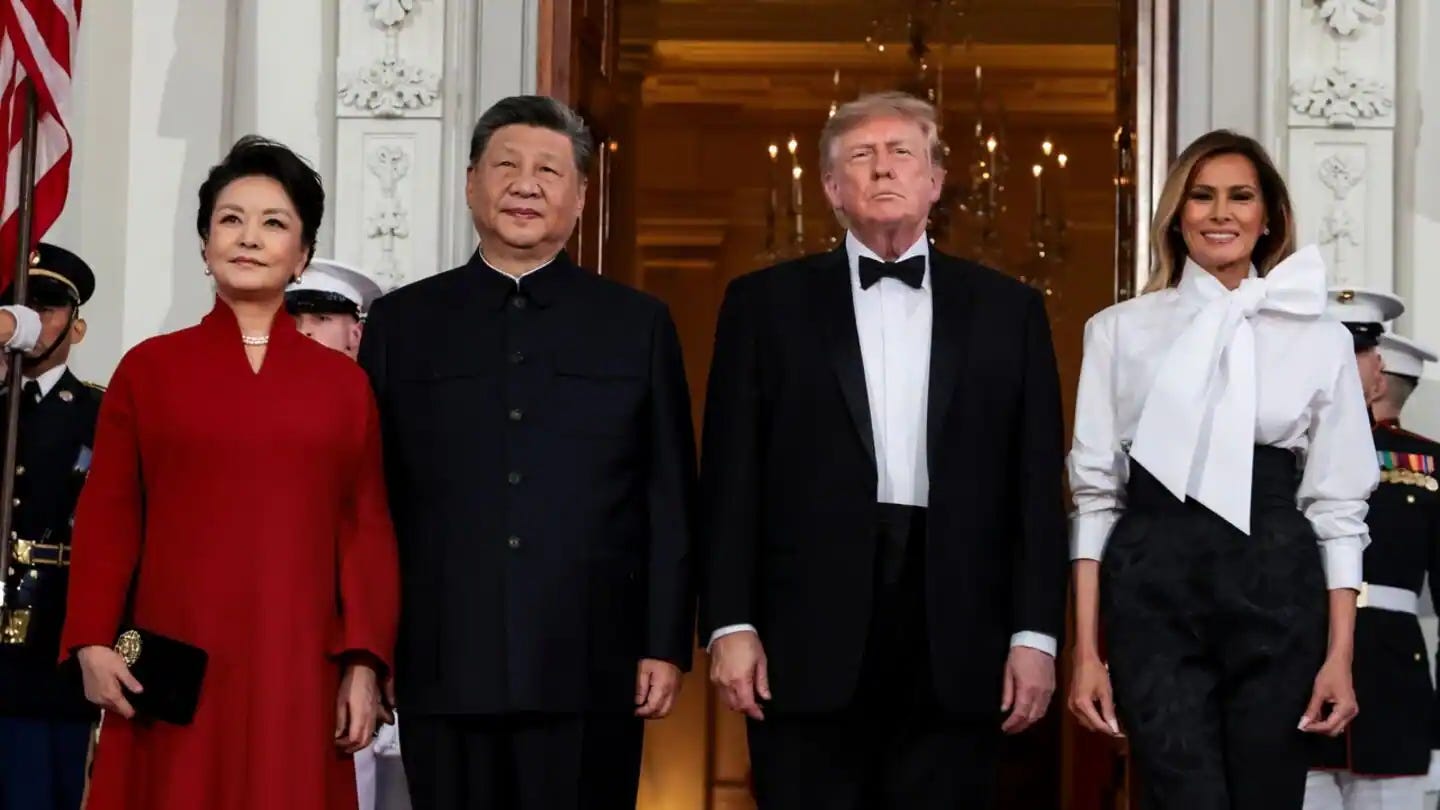
Wang Yi said that in September, the heads of state experienced a series of diplomatic climaxes and spectacular moments. After visiting Central Asia, the Middle East, and South Asia, President Xi Jinping traveled across the Pacific to embark on a world-renowned trip to the United States. This marks President Xi Jinping’s first state visit to the United States in 11 years, achieving mutual visits between the two heads of state within half a year and creating a historic record in China-U.S. exchanges. The visit was packed with content and purpose, and President Xi Jinping and President Trump had a candid, in-depth exchange of views on strategic and overall issues concerning China-U.S. relations and global trends in a mutually respectful and friendly atmosphere. The U.S. side has given President Xi Jinping the highest level of courtesy. President Trump and First Lady personally attended the airport to welcome them, the military band played the national anthems of China and the United States, 21 salutes were fired on site, and honor guards from various branches lined up in salute, marking the grand opening of the visit. The next day, President Trump held a grand welcome ceremony for President Xi Jinping at the White House, where the two heads of state delivered important speeches and reviewed the honor guard and fighter jets flying over the White House side by side. That evening, President Trump and his wife decorated the White House’s East Hall in Chinese red and held a grand welcoming state banquet for President Xi Jinping and his wife, gathering U.S. federal officials and distinguished figures from all walks of life. These carefully designed protocol arrangements highlight the U.S. side’s full respect for President Xi Jinping and its high regard for China-U.S. relations.
Domestic and international media focused on this visit, frequently using front-page headlines to report and interpret it, generally considering it a historic visit of milestone significance. Amid the intertwined international situation, this visit continued the positive effect of the Beijing meeting between the two heads of state, leading to new developments in the constructive strategic stability relationship between China and the United States, and sending positive signals of mutual progress, peaceful coexistence, and mutual benefit, benefiting both countries and the world.
1. Expanding the New Positioning of China-US Relations
Wang Yi said that head-of-state diplomacy is the stabilizing star of China-U.S. relations. Since President Trump took office again, the two heads of state have met three times, held five phone calls, and exchanged multiple letters, maintaining close ties and forming a model of mutual respect and sincere treatment, becoming the most valuable strategic asset in China-U.S. relations. At every critical moment in the great ship of China-U.S. relations, the head of state guides the direction through diplomacy.
In May this year, during President Trump’s visit to China, the two heads of state jointly confirmed the new positioning of the constructive strategic and stable China-U.S. relationship, clearly striving toward a direction of cooperation-oriented, moderately competitive, controllable differences, and promising peace. The new positioning not only reflects the reality of steady progress in China-U.S. relations but also highlights both sides’ expectations for continuous improvement, representing an important step toward the correct path of bilateral cooperation. Following the directions indicated by the two heads of state, both sides actively promoted dialogue and cooperation, properly handled differences and frictions, and achieved overall stability in China-U.S. relations.
An important political outcome of this visit was that President Xi Jinping and President Trump further expanded the connotation of the new positioning of China-U.S. relations, clarified the importance of respect, fairness, and equality, and agreed to build a “constructive strategic and stable China-U.S. relationship based on respect, fairness, and equality,” providing clearer strategic guidance for the U.S. to explore ways of great power cooperation. Respect means respecting each other’s sovereignty and territorial integrity, respecting each other’s chosen social systems and development paths, and respecting each other’s core interests and major concerns. Fairness means engaging in mutually beneficial cooperation, negotiating differences to resolve differences, avoiding zero-sum games of mutual gain, and not pursuing absolute advantage on one side. Equality means both countries have equal sovereignty, with no hierarchy, no bullying, and equal resolution of each other’s concerns and balanced development of cooperation across various fields. President Xi Jinping pointed out that the two major powers, China and the United States, shoulder the historic responsibility of promoting human development and progress. They should demonstrate the responsibility of major powers, align with the expectations of the people and the trends of the times, and explore a new path for the proper coexistence of major powers. To achieve the great rejuvenation of the Chinese nation and make America great again, we can proceed in parallel, mutually achieve each other, and benefit the world.
It’s normal for China and the US to have different situations, and disagreements are normal. Some of these differences are sharp, and many conflicts are complex. However, properly handling differences and contradictions while seeking common ground while reserving differences is an essential part of the constructive strategic and stable China-U.S. relationship. The two heads of state agreed to leverage the coordinating role of political and diplomatic channels. The militaries of both countries should maintain regular dialogue. Departments such as the economy, trade, finance, law enforcement, and cultural affairs need to strengthen communication, build trust, resolve doubts, manage differences, and build mutual trust. President Xi Jinping clarified China’s principled position on the Taiwan issue, emphasized China’s firm commitment to safeguarding national unity and territorial integrity, urged the US to uphold its correct stance against ‘Taiwan independence,’ handle the Taiwan issue prudently, and remove interference from China-US strategic cooperation and the development of bilateral relations.
Wang Yi said that, as President Xi Jinping pointed out, the ‘Thucydides Trap’ can be overcome. The constructive strategic stability relationship between China and the U.S. is not just a slogan, but should be an action that moves toward each other. As long as respect, fairness, and equality are truly demonstrated, China and the U.S. will surely forge a path through dialogue and consultation that allows two countries with different civilizations, systems, and paths to coexist peacefully for a long time on this planet.
2. Opening up new space for China-US cooperation
Wang Yi said that as the world’s two largest economies, the fact that China and the U.S. are intertwined is an objective fact; unity benefits both sides, while conflict harms both—this is a historical lesson. Mutual achievement and win-win cooperation are the only correct choices. China-U.S. cooperation concerns the well-being of the peoples of both countries and also affects the global political and economic landscape.
On the eve of the visit, the economic and trade teams of both sides held a new round of consultations and reached a new joint arrangement, including establishing and advancing a trade council and investment council, setting up an agricultural working group, implementing a “$30 billion” reciprocal tax cut, and extending the results of the Kuala Lumpur economic and trade negotiations. These efforts have stabilized bilateral economic and trade relations, strengthened market confidence, and benefited both countries’ industries, their people, and even the global economy. China-U.S. economic and trade relations have gone through many twists and turns, and today’s stable situation has not come easily. Some U.S. forces have generalized the concept of national security, politicized economic and trade issues, suppressed Chinese enterprises in the U.S., restricted Chinese investment in the U.S., created market access barriers, and promoted “decoupling and chain breaks.” This does not serve the interests of either party and only narrows the overlap of interests between the two sides. President Xi Jinping pointed out that cooperation is a two-way street; stabilizing China-U.S. economic and trade relations requires both lengthening the list of cooperation and narrowing the list of problems. The U.S. side should treat Chinese companies fairly, uphold the spirit of equality, respect, and reciprocity, and find solutions through dialogue and negotiation. Both sides should move toward each other, adhere to a win-win orientation, promote the sustained, stable, and positive development of China-U.S. economic and trade relations, and better benefit the peoples of both countries.
China-U.S. law enforcement cooperation has effectively safeguarded the lives and property of the people of both countries, and has enhanced the “security factor” of bilateral relations. Fentanyl abuse has caused irreparable trauma to many American families. Although this issue was not caused by China, China has always acted with the utmost goodwill and efforts to assist the U.S. in responding to the fentanyl crisis from a humanitarian perspective and the broader context of China-U.S. relations. Since the Beijing meeting, China has once again added new controls for precursor chemicals and strengthened export controls, working with the US to solve multiple drug-related cases, demonstrating China’s sincerity. The two heads of state instructed law enforcement agencies to continue strengthening cooperation and jointly combat transnational crime.
Wang Yi said, ‘Those who act always succeed, those who act always arrive.’ Facts have proven that China and the U.S. can accomplish a series of major and beneficial things through cooperation. Every progress in China-U.S. relations brings tangible benefits to the international community. All departments and levels on both sides must implement the important consensus reached by the two heads of state with a nail-driven spirit, neither neglect small good nor commit small evil, achieve mutual benefit through pragmatic cooperation, achieve mutual success through healthy competition, and jointly open up a better prospect for China-U.S. relations.
3. Build a new bridge of China-U.S. friendship
Wang Yi said that people-to-people connectivity provides solid strength and lasting momentum for the development of China-U.S. relations. As President Xi Jinping pointed out, the hope for China-U.S. relations lies in the people, the foundation among the grassroots, the future in youth, and the vitality in local communities. “Ping-Pong Diplomacy” has opened the door to long-sealed China-U.S. exchanges; “Guling Connection” has passed down centuries-old friendship; Iowa has witnessed touching stories of local cooperation; and the gentle streams of exchanges between the peoples of the two countries have gathered into the vital source that nourishes the development of bilateral relations.
During this visit, President Xi Jinping repeatedly mentioned the highlight moments of China-U.S. civilian friendship: the two peoples fought side by side in World War II, and Chinese military and civilians rescued hundreds of American pilots at the cost of hundreds of lives. Chinese desert control worker Yin Yuzhen and her American friend Cycos reunited in China after more than 20 years; the saplings planted in the desert years ago have now become forests. Sincere words and touching stories resonated strongly with people from all walks of life in China and the United States. President Trump also recounted in his speech the historical experience of China and the U.S. becoming allies during World War II, and the two peoples joining hands to win the war. He expressed that the friendship between the U.S. and China spans thousands of miles and lasts for over a hundred years, and expressed willingness to continue cultivating friendship between the two countries to bring lasting prosperity and security to future generations. “The friendship between nations lies in the closeness of the people.” The warmth and strength of mutual understanding and affection among the people are the warmest and most powerful, enough to break down barriers, wash away noise, and connect the vast Pacific Ocean with each other.
To promote China-U.S. cultural exchanges, President Xi Jinping announced a series of new initiatives. Building on the achievement of the “50,000 Goals in 5 Years” initiative two and a half years ahead of schedule, President Xi Jinping announced that over the next five years, China will invite 100,000 American youths to China for exchange and study. From 50,000 to 100,000, the growth is not just a number, but also an action to expand youth exchanges and gather youthful strength for China-U.S. friendship. The most popular news among Americans is that the giant pandas “Pingping” and “Fushuang” are about to settle at the Atlanta Zoo. Giant pandas are messengers of friendship, deeply loved by the American public, and the panda bond between the two countries has spanned more than half a century. The arrival of “Pingping” and “Fushuang” will add another beautiful story to China-U.S. friendship. “Rose diplomacy” was another highlight of this visit. When President Trump visited Zhongnanhai in May, he highly praised Chinese roses. A few months later, the Chinese rose carried the best wishes of the Chinese people across the ocean to the White House in the United States, becoming a new symbol of friendship between the two countries.
It is worth mentioning that President Trump and his wife invited President Xi Jinping and his wife to visit the U.S. National Archives together, which is similar to President Xi’s visit to the Temple of Heaven in May, reflecting the understanding and respect between China and the U.S. for each other’s historical and cultural heritage. China and the U.S. have different cultural traditions and social systems, but these differences do not necessarily lead to confrontation; instead, they provide broad space for exchange and mutual learning.
The gentle and approachable diplomacy of the lady injected a soft touch into this visit. Professor Peng Liyuan accompanied President Xi Jinping on her visit to the United States, and at the invitation of President Melania of Trump, they jointly visited the National Museum of Asian Art. Together, they enjoyed Chinese songs such as “Jasmine Flower” sung by American youth, experiencing artistic fusion and musical resonance, and bringing the hearts of the peoples of both countries closer together.
Wang Yi stated that only through heartfelt connection can the relationship endure long. The continued progress of China-U.S. relations requires both a “handshake” at the head of state level and the “hand-holding” of ordinary citizens. Under the strategic guidance of the two heads of state, we will continue to pave the way for China-U.S. cultural exchanges, broaden channels and provide momentum for exchanges and cooperation in youth, education, culture, tourism, sports, and other fields, allowing the tree of friendship between the peoples of our two countries to take deeper root and grow higher.
4. Demonstrating new commitments to major powers
Wang Yi said that in the face of the intertwined international situation, the global significance of China-U.S. relations is even more prominent. Whether addressing global challenges or cooling down hot issues, constructive China-U.S. interaction is indispensable. President Xi Jinping pointed out that although China-U.S. cooperation cannot solve all the world’s problems, without bilateral cooperation, many global problems are difficult to solve. President Trump stated that joint U.S.-China cooperation will lay a solid foundation for peace and prosperity in the world for decades to come. During this visit, the two heads of state exchanged in-depth views on major international and regional issues of common concern, agreeing to strengthen coordination and make due contributions to world peace and development.
Ongoing tensions in the Gulf and Middle East are impacting global energy security, geopolitical dynamics, and the international order. As a responsible major power, China has always firmly been a builder of peace in the Middle East, a promoter of stability, and a supporter of development. President Xi Jinping has successively put forward a series of initiatives and proposals dedicated to peace and stability in the Middle East, which have received broad recognition and positive responses from the international community. During this visit, President Xi emphasized that the sovereignty and security of all countries should be respected, encouraged all parties to adhere to peaceful choices, supported the US-Iran return to Islamabad through the Memorandum of Understanding, and called for the early restart of dialogue and negotiations, ultimately reaching a comprehensive agreement including nuclear issues. International public opinion highly praised China’s objective and fair stance, believing that China focuses on the root causes of problems, emphasizes addressing both symptoms and root causes, respects the sovereignty of all countries, promotes dialogue and consultation, plays a constructive role in cooling the Middle East situation, and looks forward to China providing Chinese solutions and wisdom to address more pressing issues.
The healthy, safe, and orderly development of artificial intelligence concerns humanity’s future and cannot be separated from China-US cooperation. During this visit, President Xi Jinping had in-depth discussions with President Trump on artificial intelligence issues, pointing out that both China and the U.S. are major AI powers and have the capability and responsibility to develop and manage AI well, ensuring that AI development is always controlled by people and benefits the people. China and the U.S. should each play to their strengths rather than defend against each other. The two heads of state agreed to make good use of the China-U.S. AI dialogue mechanism, communicate its risks and benefits, and jointly prevent AI abuse and misuse.
This year marks the 80th anniversary of the Tokyo Trials. Both China and the U.S. are permanent members of the UN Security Council, and maintaining postwar international order and preventing the resurgence of militarism is a shared responsibility of both sides.
China and the U.S. will respectively host the APEC Leaders’ Informal Meeting and the G20 Leaders’ Summit in the fourth quarter of this year. The two heads of state confirmed their mutual support, continuously injecting momentum into Asia-Pacific cooperation and global governance.
Wang Yi concluded by saying that this historic visit enriches the connotation of the constructive strategic stability relationship between China and the United States, maintains the overall stability of China-US relations, creates and writes a new chapter in China-US relations, and will have a profound impact on world peace and development. From “Gathering in Beijing” to “Meeting in Washington,” President Xi Jinping has always guided China-U.S. relations steadily and long-term with a far-sighted strategic vision and broad-mindedness to benefit the world. President Xi Jinping’s calm and confident leadership style has left a deep impression on all sectors of the United States, inspiring the American people’s enthusiasm to approach and perceive China, and sowing the seeds of friendship in American society. In just one month, President Xi Jinping made three foreign visits, radiating to neighboring countries, connecting with the Global South, and strategizing diplomatic strategies, making China’s philosophy more popular, highlighting the role of a major power, and further enhancing international influence. We must continue to deeply understand and practice Xi Jinping Thought on Socialism with Chinese Characteristics for a New Era, especially Xi Jinping Thought on Diplomacy, and, with a more vigorous spirit and firmer will to strive, make every effort to open up a new chapter in major-country diplomacy with Chinese characteristics in the new era, create a more favorable international environment and provide more solid strategic support for comprehensively advancing the construction of a strong nation and the great cause of national rejuvenation through Chinese-style modernization. [My Emphasis]
Very typical Chinese report that emphasizes the positive and barely mentions negatives. Those that closely follow US-China relations know there are many negatives. However, it’s clear Chinese diplomacy strives to accentuate the positive. Xi well knows that people-to-people relations are the best antidote for the juvenile levels of propaganda used to smear China and that doubling the number of interaction invitations is the most powerful and efficient way to subvert the subverters. Xi’s confidence made it pointless to tell Trump his efforts to slow China’s development all failed and will continue to fail. So, wise up and smell the roses.
I think it’s worth reading the before and after visit editorials by Global Times and see how they meld with Wang Yi’s report: before and after.
*
*
*
It’s hard to ask for contributions given our current uncertain circumstances, but I must ask for them just the same. Please consider contributing when subscribing. Thanks very much for those who have in the past and do so now!
Far Eastern culture is difficult for people from "the West" to understand, because we often project our way of thinking and our behavioral patterns onto them, even when interacting with other cultural spheres. This lays the groundwork for misunderstandings. I personally am absolutely certain that Trump's "Hitler speech" before the UN General Assembly left an extremely negative impression on the Chinese as well, and that the Chinese do not harbor even the slightest hope that there will be any development towards peaceful coexistence between the US and China. Nevertheless, there is no alternative to diplomacy between superpowers that possess nuclear weapons. Especially so when the nuclear power represented by a narcissistic, psychologically unstable, and insane president with a god complex is doing everything in its power to destroy "my" country. This also explains why the Russian leadership is playing along with the charade involving Witkoff and Kushner.
One of the standout features of Chinese (and Russian) diplomacy is their irrepressible bonhomie when speaking about international rivals with whom they have difficult relations. Despite being labeled in very negative ways by the USA or an EU country, China and Russia will continue to speak in relentlessly polite diplomatic language about their adversary. And they'll do so despite receiving no such consideration from the opposing side. Take the USA, for instance. Does anyone doubt that the US wants to put a dagger to China's throat, or doubt that China is aware of it? Nevertheless when you read a Chinese foreign ministry readout of Xi and Trump's meeting, you would think they're old friends.
No one can deny that China is trying hard to make things work with the USA, even if that attitude isn't shared in Washington.